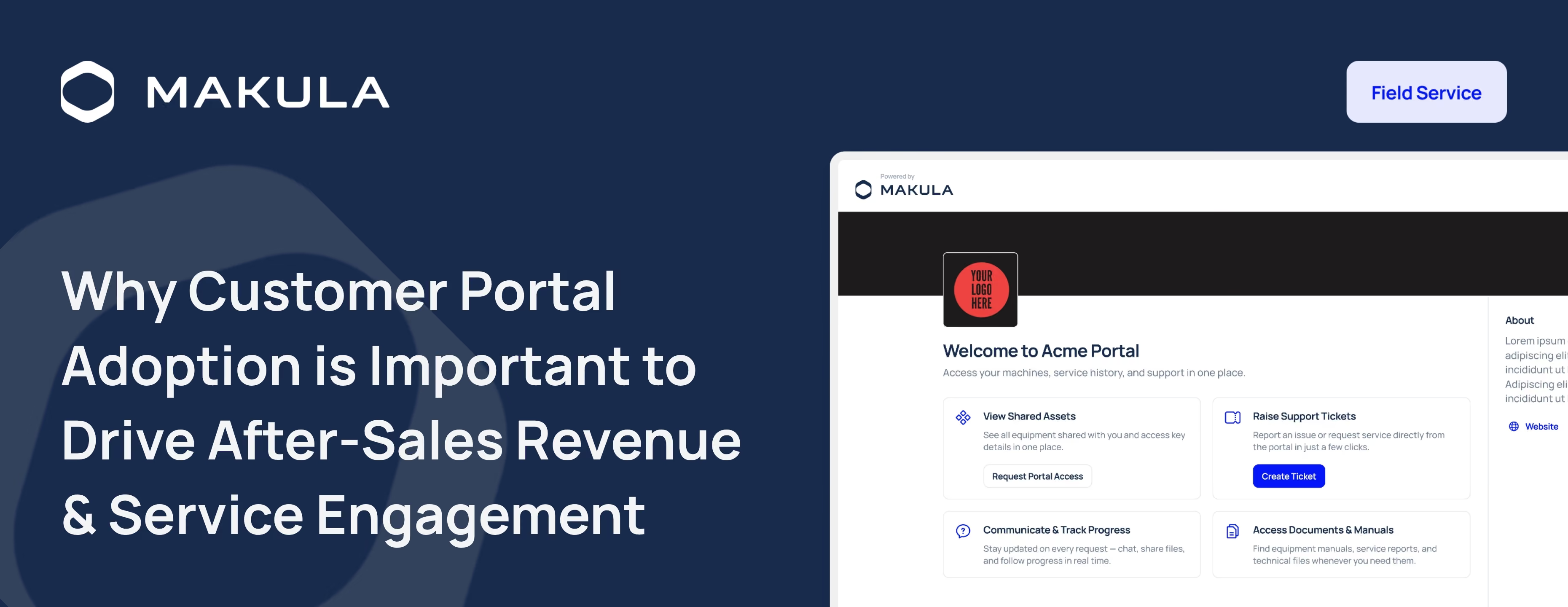
There is a frustration that runs quietly through almost every OEM after-sales team: customers only get in touch when something breaks. Preventive services, software upgrades, maintenance packages, training programmes, and performance optimisation offerings often go entirely unnoticed, not because customers do not need them, but because they simply forget they exist.
In today's digital-first world, visibility drives behaviour. If customers cannot easily see what you offer, they will not think to buy it. This is where customer portal adoption becomes a strategic growth lever rather than just a convenience feature.
A well-designed customer portal keeps your services constantly present within the customer's operational environment. Without it, even your most valuable offerings fade into the background noise of daily operations. Over time, that invisibility directly reduces upsell potential, weakens relationships, and limits long-term revenue growth.
The numbers reinforce this urgency. According to a 2024 survey, 66% of manufacturers plan to invest in customer portals, up from 50% the previous year, a clear signal that digital self-service is rapidly becoming an industry baseline, not a differentiator.
The Hidden Problem: Services Exist, But Customers Cannot See Them
Most OEMs invest heavily in building out their after-sales catalogue, preventive maintenance programmes, spare parts packages, extended warranties, software upgrades, performance optimisation services, and training consultancy. Yet adoption rates remain far lower than expected.
The core issue is rarely pricing or demand. It is awareness and accessibility. When services are communicated only through periodic emails, sales calls, or occasional reminders, they are easily forgotten. Customers operate in fast-paced environments where priorities shift constantly. If your offerings are not embedded directly into their daily workflows, they lose relevance.
Consider Caterpillar (CAT), one of the world's leading equipment manufacturers. Rather than relying on passive communication, CAT built a multi-tier aftermarket approach focused on supporting customers throughout the entire lifecycle of its equipment, covering parts, repairs, financing options, warranties, and strategic rebuilds.
This proactive model, backed by a connected digital environment, helped the company achieve an operating cash flow of $3.0 billion in Q2 2024 alone. The lesson for mid-market OEMs is clear: visibility into services is not accidental; it is engineered.
This is precisely why customer portal adoption has become a critical priority for OEMs pursuing sustainable after-sales growth.
Read more: Why Customer Portals Are Core to Field Service Experience
Why Customers Forget Without a Portal
1. Out of Sight Means Out of Mind
Customers are focused on keeping their operations running. If service options are not visible within the tools they use every day, those options are quickly deprioritised.
A customer self-service portal acts as a persistent, always-on reminder of available services, upcoming maintenance windows, and improvement opportunities, without requiring your sales team to chase every conversation.
2. No Contextual Triggers for Upselling
Upselling works best when it is presented at exactly the right moment:
- When a machine reaches a service milestone
- When performance starts to decline
- When parts are being replaced
- When a warranty period is approaching its end
- When usage patterns indicate an imminent fault
In a disconnected digital environment, these moments are rarely captured or acted upon. A modern OEM customer portal creates the contextual triggers needed to surface the right service offer at the right time, when customers are most receptive.
3. Manual Outreach Does Not Scale
Your sales and service teams cannot realistically maintain consistent, personalised communication with every customer across your installed base. Manual outreach is slow, inconsistent, and expensive at scale.
A field service customer portal automates engagement by surfacing recommendations, maintenance alerts, and service offers directly within the customer interface, no chasing required.
4. Silence Is Mistaken for Inactivity
Many customers operate under a quiet assumption: if something was important or available, the OEM would have told them. When they do not hear from you, they assume there is nothing new to consider.
Portals break this pattern by creating ongoing digital engagement that does not rely on someone remembering to send an email.
The Upsell Challenge: Breaking the Adoption Cycle
There is a common internal barrier that makes this problem self-reinforcing:
- Customers do not use the portal → they do not see available services
- They do not see services → they do not buy upgrades
- They do not buy upgrades → ROI on the portal appears low → investment stalls
Breaking this cycle requires a shift in thinking. Portals are not technology products. They are customer experience platforms. Improving customer portal adoption is ultimately about demonstrating genuine value at every touchpoint, not pushing features.
The question to ask is not "how do we get customers to log in?" but rather "what would make them want to come back every day?"
The Business Case: What the Data Says
The financial argument for portals is compelling and backed by hard evidence.
According to McKinsey, OEMs with full digital insight into their machines, combined with prioritised service sales, can increase aftermarket revenue by 30 to 60% within three to five years.
For companies in sectors such as aerospace, defence, construction, and medical manufacturing, aftermarket services already account for as much as 40% of total revenue and 50% of profits.
Meanwhile, 81% of customers now actively want brands to offer more self-service options that let them find answers on their own, and 80% of high-performing service organisations already offer a self-service solution compared to only 56% of lower performers.
Despite this, many OEMs have yet to build the digital infrastructure needed to capitalise on these expectations, leaving significant revenue on the table.
Traditional vs Portal-Enabled Service: A Direct Comparison
The table below illustrates the operational gap between OEMs with and without an active customer portal:
The gap compounds over time. Every service interaction that happens outside a connected portal is a missed data point, a missed upsell opportunity, and a missed chance to deepen the customer relationship.
What Strong Adoption Actually Unlocks
When customers actively and regularly use a portal, the commercial impact extends well beyond convenience.
From a revenue perspective, a high-engagement portal environment directly supports:
- After-sales upselling opportunities through contextual, timely offers
- Preventive maintenance renewals before issues escalate
- Service contract upsell campaigns tied to asset lifecycle events.
- Spare parts revenue growth through integrated ordering
- Training programme enrolment for new operators or upgraded equipment
From a relationship perspective, portals build trust by enabling transparency, faster communication, asset visibility, service history access, and performance insights.
In manufacturing and industrial environments, where long-term relationships depend heavily on reliability and responsiveness, these capabilities matter enormously.
Portals and Installed Base Monetisation
One of the most significant missed opportunities for OEMs is the under-monetisation of their existing installed base. Most customer interactions are reactive: a machine fails, a customer calls. Portals shift that model from reactive to proactive.
A connected digital environment enables:
- Personalised service recommendations based on real usage data
- Lifecycle-based offers tied to asset age and condition
- Usage-driven maintenance prompts before failure occurs
- Targeted upgrade suggestions at the right moment
This directly supports installed base monetisation by converting data and asset intelligence into tangible revenue. Deloitte's analysis shows that the operating margins of after-sales services are 2.5 times greater than those for new equipment sales — meaning the financial upside of unlocking your installed base is substantial.
Tools such as Customer Management help centralise asset visibility across the installed base, while intelligent capabilities like AI Maintenance Copilot deliver predictive insights that make the portal genuinely indispensable, not just a place to log tickets, but a tool customers return to because it helps them make better operational decisions.
The Psychology Behind Portal Adoption
Understanding why customers adopt, or abandon, digital platforms is essential for improving engagement. Customers commit to new tools when they perceive:
- Immediate usefulness: it solves a real problem, fast
- Time savings: faster than the alternative
- Reduced uncertainty: they know where to go and what to expect
- Better decision support: insights they could not get elsewhere
- Operational control: visibility over their own assets and schedules
If your portal simply mirrors information customers already receive through other channels, adoption will remain low. But if it becomes the fastest, most reliable way to solve a real problem, usage grows naturally and consistently.
Practical Strategies to Improve Portal Adoption
1. Start with high-value, high-urgency use cases:
Introduce the portal by solving an immediate problem, service request submission, asset history access, or maintenance alerts. Immediate utility creates an initial habit.
As detailed in When Customers Can't Raise Service Requests Themselves, the inability to self-serve is a pain point many customers feel acutely; solving it first makes the portal instantly valuable.
2. Embed portal usage into your service workflows:
Train technicians and support staff to direct customers to the portal instead of email or phone, wherever possible. Behaviour reinforcement accelerates adoption far more effectively than promotional messaging.
3. Personalise the experience:
Customers engage more deeply when the content they see is tailored to their specific assets, usage patterns, and operational context.
Nearly half of customers (49%) say they are more likely to become repeat customers after a personalised experience. Generic dashboards are quickly ignored; personalised insights are acted upon.
4. Demonstrate financial impact clearly:
Show customers how portal-driven insights have helped reduce downtime, lower maintenance costs, or extend asset life. When ROI is visible, motivation to engage follows naturally.
5. Invest in proper onboarding:
Adoption frequently stalls not because customers lack interest, but because onboarding is rushed or unclear. The top reasons for slow or failing portal adoption include reluctance to embrace digital tools, lack of cross-functional collaboration, and lack of ownership of digital at the local level. Structured onboarding, with real support, not just a tutorial video, addresses all three.
The Competitive Advantage of High Adoption
OEMs with strong customer portal adoption gain compounding advantages over time:
- Faster and more predictable upsell cycles
- Higher service contract renewal rates
- Deeper customer loyalty and reduced churn
- Richer operational data for smarter decision-making
- A service operation that scales without proportionally increasing headcount
Most importantly, they become embedded in the customer's daily workflow — making the relationship stickier and the cost of switching providers significantly higher. In competitive markets where product parity is common, this operational embeddedness is a genuinely durable advantage.
Conclusion
Customers rarely ignore valuable services intentionally. More often, they simply forget, because those services are not visible at the moment they are needed most.
A portal changes that dynamic completely. It keeps your offerings present, contextual, and actionable within the customer's daily operations, turning passive awareness into active engagement and, ultimately, revenue.
For OEMs aiming to increase upsells, strengthen customer relationships, and unlock the full commercial value of their installed base, improving customer portal adoption is not just a digital initiative; it is a strategic business decision with measurable returns.
To see how an intelligent portal can transform your customer engagement and after-sales performance, book a demo with Makula today and discover what your service offering could look like with the right platform behind it.