
If your maintenance team is still relying on memory, spreadsheets, or guesswork to decide when to reorder spare parts, you are not alone.
Many facilities struggle with the same problem: parts are ordered too late, stockouts disrupt maintenance work, and excess inventory ties up working capital. Without a clear reorder policy, teams end up reacting to shortages instead of planning ahead.
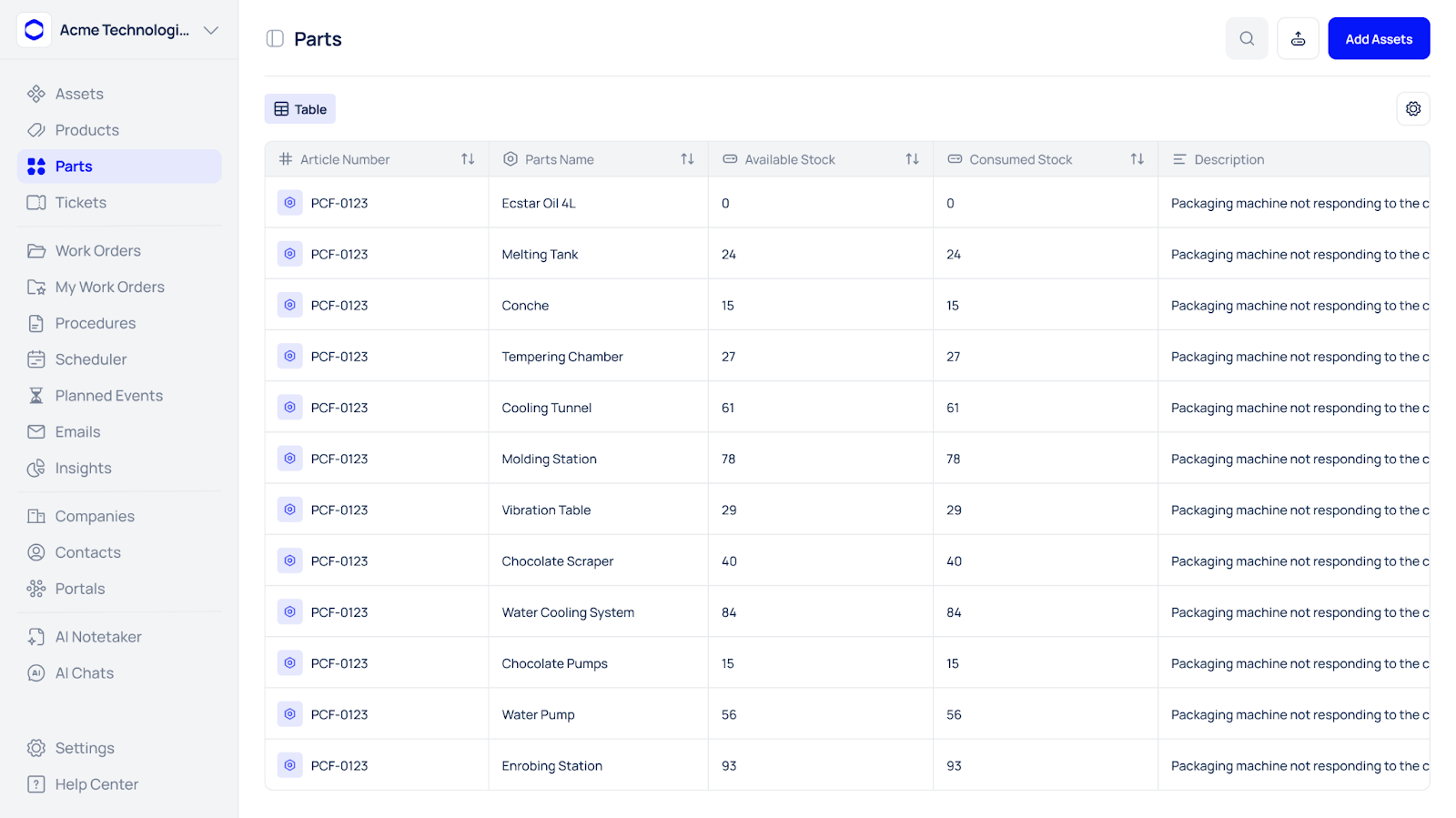
Makula CMMS helps maintenance teams bring structure to spare parts reorder planning so the right parts are available before they are needed.
Why reorder policies often fail
Reorder policies usually break down for a few simple reasons:
- lead times are not tracked properly
- usage rates are outdated or inconsistent
- safety stock is not defined clearly
- ordering decisions depend on individual judgment
- inventory records are split across different systems
When that happens, teams either run out of critical parts or overstock items that do not move quickly enough.
A better approach is to use a simple, repeatable policy based on real usage and supplier data.
What you need before you start
To build a reorder policy, you only need a few key inputs.
When these values are accurate, spare parts reorder planning becomes much easier to manage.
Step 1: Calculate average demand
Start by reviewing how often a part is used over a fixed period, such as a week or a month.
For example, if a bearing is used 10 times per week on average, that number becomes the foundation of your reorder policy.
In Makula CMMS, this kind of information can come from maintenance history, work orders, and part usage records.
Step 2: Confirm supplier lead time
Lead time is the number of days or weeks between placing an order and receiving the part.
This matters because a long lead time increases the risk of stockouts. If a critical component takes three weeks to arrive, you must reorder early enough to cover that gap.
A good reorder policy always reflects actual supplier performance, not just estimated delivery promises.
Step 3: Add safety stock
Safety stock is the extra quantity kept to protect against uncertainty.
It helps cover:
- unexpected breakdowns
- demand spikes
- supplier delays
- shipping disruptions
For maintenance teams, this buffer is especially important for critical spares that can stop production if they are missing.
Step 4: Use the reorder point formula
A simple reorder policy can be calculated with this formula:
Reorder Point = (Average Usage × Lead Time) + Safety Stock
For example:
- Weekly usage: 10 units
- Lead time: 3 weeks
- Safety stock: 15 units
Calculation:
(10 × 3) + 15 = 45 units
That means once stock reaches 45 units, the system should trigger a reorder.
Step 5: Validate and refine
A reorder policy should not be treated as static.
Review it regularly and adjust it based on:
- actual consumption
- supplier performance
- seasonality
- asset criticality
- maintenance history
If stockouts still happen, increase the safety stock. If you are overstocking, review whether the reorder point is set too high.
Why an interactive planner works better
Traditional reorder planning usually fails because spreadsheets are:
- hard to standardize
- easy to break
- slow to update
- disconnected from live maintenance activity
An interactive planner solves this by guiding users through the process step by step and calculating reorder points automatically.
In Makula CMMS, that means maintenance teams can manage reorder planning more consistently and connect it directly to real inventory usage.
Benefits of structured reorder planning
A strong reorder policy helps teams:
- reduce stockouts
- improve uptime
- avoid emergency purchases
- lower excess inventory
- improve purchasing decisions
- support maintenance planning with better data
Instead of guessing, your team can reorder with confidence.
Conclusion
Spare parts reorder planning should be simple, repeatable, and based on real maintenance data.
With Makula CMMS, maintenance teams can use usage rates, lead times, and safety stock to build smarter reorder policies that reduce shortages and keep operations moving.
Build your reorder policy today and take control of your spare parts planning in 10 minutes.