When an FDA or EMA inspector asks you to demonstrate that maintenance on a qualified piece of equipment followed its validated schedule, a binder of signed sheets won't reassure them. They want a defensible record: who performed the task, when, against which procedure, and what changed afterwards. If your current logs can't answer that cleanly and quickly you have an exposure that no amount of good intentions will close.
This guide is written for maintenance managers, engineering leaders, validation stakeholders, QA-facing operations leaders and compliance-conscious buyers in pharmaceutical manufacturing. It won't tell you how to run your maintenance programme. It will tell you precisely what to demand from preventive maintenance software for pharma manufacturing so the records you produce survive a GMP inspection.
Here's what we'll cover:
- Why paper and spreadsheet logs are a liability under GMP
- The evaluation criteria that produce defensible, audit-ready maintenance records
- How time-based PM schedules map to qualified equipment
- A side-by-side comparison table for your shortlist
- FAQs for buyers at the decision stage
See GMP-Ready Preventive Maintenance in Makula CMMS for Pharma Manufacturing
Discover how pharma manufacturing teams can build audit-ready preventive maintenance records that stand up to FDA and EMA inspections. See how Makula helps you manage time-based PM schedules, controlled SOP-driven work orders, and complete ALCOA+ compliant audit trails with full traceability, sign-offs, and change history.

Why Paper and Spreadsheet Logs Fail Under GMP
Pharmaceutical manufacturing operates under some of the most demanding recordkeeping expectations of any industry. Maintenance on qualified equipment isn't a back-office task; it's part of the evidence you present when an inspector tests whether your validated state has been preserved.
Paper and spreadsheets weren't designed for that burden. They scatter the truth across multiple sources: a signed checklist in one binder, a schedule in a spreadsheet on someone's desktop, the actual completion date in a technician's memory. When an inspector asks for the full PM history of a single qualified asset, assembling that picture takes hours, and any gap reads as a finding.
There's a deeper problem. Spreadsheets can't enforce data integrity. They don't capture who made an entry, they don't prevent silent edits, and they don't preserve a change in history. Against ALCOA+ expectations that records be attributable, legible, contemporaneous, original, accurate, and complete, a spreadsheet falls short on almost every count.
The takeaway: if your maintenance records can't show what was scheduled, what was completed, when, by whom, and what was subsequently changed, they aren't audit-ready. They're a risk waiting for an inspection.
What to Demand from Pharma PM Software

When you evaluate GMP preventive maintenance software, a handful of capabilities separate platforms that genuinely produce defensible records from those that simply move the paperwork onto a screen. Here's what matters.
Validated PM Schedules on Qualified Assets
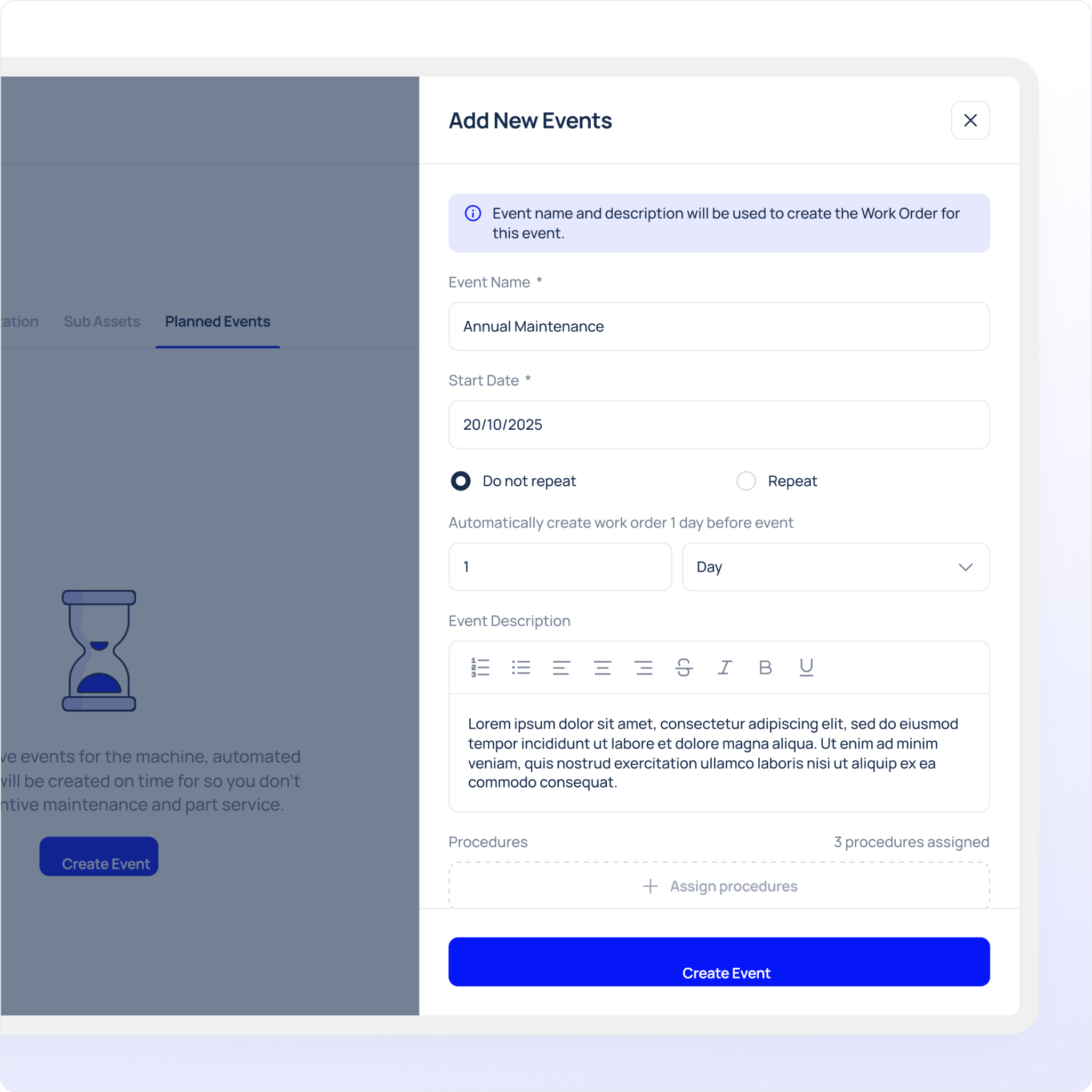
Maintenance on qualified equipment must follow defined, time-based PM schedules rather than ad hoc intervention. Your software should let you define those schedules precisely and hold them stable, so the maintenance frequency matches what your qualification documentation specifies.
Look for:
- Fixed-interval scheduling (daily, weekly, monthly, annually) per asset or asset class
- Recurrence anchored to the completion date so schedules don't drift over time
- A clear link between each schedule and the qualified asset it applies to
- Controlled changes to schedules, with a recorded reason and user attribution
The aim is consistency: the same task, at the same defined frequency, every time with a record proving it.
Automatically Generated Work Orders with Controlled SOP Checklists
A scheduled PM is only defensible if the technician follows the correct, current procedure. Automatic work-order generation removes the manual step where the wrong version slips through.
Each work order should generate at the right time, carrying a controlled SOP checklist appropriate to the asset. Required readings, mandatory fields and procedural steps should be built into the task, so every technician on every shift follows the same approved procedure with no informal variation and no reliance on memory.
Complete PM History with Timestamps, Sign-Off and Change History
This is the heart of audit-ready maintenance records. Every PM should leave a complete, timestamped record showing what was scheduled, when it was completed, the tasks performed, and the technician who signed off captured in the system, not on a sheet filed elsewhere.
Three things matter most here for data integrity:
- Timestamps applied automatically by the system, not entered by hand
- User sign-off attributed to a named, authenticated individual
- Change history that records any edit what changed, who changed it, and when without overwriting the original entry
Together, these support the ALCOA+ principles inspectors test against and create the tamper-evident trail a GMP audit demands.
Asset Hierarchy Tied to Equipment Qualification
Inspectors think in terms of qualified equipment and systems, not isolated tags. Your software should mirror that. A clear asset hierarchy lets you organise equipment by system, area and site, and tie each asset to its qualification status so you can pull every maintenance record for a single qualified unit in one action.
This structure also surfaces patterns. A qualified asset repeatedly running behind on its PMs is far easier to identify when the hierarchy reflects how your validated systems are actually organised.
Exportable Evidence for GMP Inspections
The final test is retrieval. Exportable, audit-ready evidence should be producible in minutes filtered by asset, system, date range and PM type in a format an inspector recognises and trusts. If producing twelve months of PM history for one qualified asset requires a data export, a spreadsheet rebuild and manual formatting, that process will fail under inspection pressure, precisely when you need it to hold.
Evaluation Criteria: At a Glance
Use this table to compare vendors against the capabilities that matter most for GMP-aligned maintenance recordkeeping.
Common Mistakes When Evaluating Pharma PM Software
Even experienced buyers slip up at this stage. Watch for these.
Accepting "it can be configured:" Some platforms can technically deliver change history or qualification-linked hierarchy but only after a long implementation project. Ask to see it live, with your kind of asset structure, not as a roadmap promise.
Testing export on clean demo data: Ask the vendor to export a year of PM history for a single qualified asset and time it. The answer should be minutes, without IT support or manual rework.
Confusing a validated system with maintenance evidence: Your PM software doesn't validate your equipment or certify your plant. It produces the maintenance records that support GMP-aligned recordkeeping and the audit-trail expectations inspectors look for. Be precise about that boundary when comparing tools, and be wary of any vendor that blurs it.
Overlooking authentication: Attributable sign-off depends on each technician having their own authenticated access. Shared logins quietly break the accountability chain that data integrity depends on.
What to Ask in a Demo
Bring these requests to any vendor demo to move past the polished walkthrough:
- Pull a complete, timestamped PM audit trail for a qualified asset: Schedule, sign-off and change history ready to hand to a GMP inspector.
- Edit a completed record: Show what the change history captures and whether the original entry is preserved.
- Generate a work order with a controlled SOP checklist: Confirm the current procedure and required fields appear automatically.
- Walk through a technician sign-off: Where's the timestamp, and is it system-applied or manual?
- Export a year of history for one asset: Time it, and check the format an inspector would actually see.
A platform built for pharma recordkeeping handles all of these comfortably. One that hesitates is showing you where your evidence will break down.
Conclusion
In pharmaceutical manufacturing, the value of preventive maintenance software shows up the moment an inspector asks you to prove that maintenance on a qualified asset followed its validated schedule. The platforms worth your shortlist are the ones that hold time-based schedules stable, generate work orders with controlled SOP checklists, and produce complete, timestamped, tamper-evident records with full change history that support GMP-aligned recordkeeping and ALCOA+ data-integrity expectations.
Your next steps:
- Map your current evidence gaps where do records live, and how fast can you retrieve them?
- Shortlist vendors against the criteria in the table above
- Insist on a live export of a single qualified asset's full PM history during the demo
- Confirm every technician has their own authenticated access
Book a demo to pull a complete, time-stamped PM audit trail for a qualified piece of equipment in Makula schedule, sign-off and change history, ready to hand to a GMP inspector.
How quickly could your current system produce that same audit trail today?