
Every manufacturing or utility plant knows the pain of unexpected downtime: lost production, urgent repairs, expedited parts and overtime, and sometimes, penalties. Industry research shows downtime is rapidly getting more expensive: the Siemens True Cost of Downtime report found that unscheduled downtime can chew through a sizable percentage of revenue in some sectors and that automotive lines can lose ~$2.3M per hour when they stop.
Survey data also tells a worrying story about frequency: many plants still experience outages monthly — roughly 69% of sites report unplanned outages at least once a month in recent industry surveys.
What is a maintenance strategy?
A maintenance strategy is the high-level plan that defines how a plant will keep assets available, safe and performing, balancing cost, risk and operational needs. A strategy answers: which assets are critical, how often and how we will perform maintenance, and what tools or monitoring will support the work (schedules, CMMS, sensors, predictive analytics). It’s the “why and how” behind your maintenance plan and should be aligned with production goals and budget constraints.
A good strategy reduces unplanned failures, makes resource needs predictable, extends asset life, and improves safety. Later, we define key terms and provide templates you can adapt.

The 4 main maintenance strategies
Below are succinct explanations, practical examples, pros/cons, and when to apply each strategy.
1) Reactive Maintenance — Run-to-Failure / Corrective
Definition: Reactive (or corrective) maintenance means you repair or replace equipment after it fails. In some settings, it’s called run-to-failure.
When to use: Low-cost, non-critical equipment where downtime has minimal impact (spare units available, replacement parts cheap).
Practical example: A small auxiliary pump on a cooling skid is left in run-to-failure mode because a spare pump is on the shelf and production isn’t impacted when the pump is down.
Pros
- Minimal planning overhead and upfront cost.
- Simple to implement.
Cons
- High risk of catastrophic or cascading failures on critical assets.
- Expedited repairs often cost more (parts, contractors, overtime).
- Hidden costs: lost production, safety, brand / regulatory impact.
Quick guidance: Use reactive for redundant, cheap assets. Avoid assets whose failure results in long outages or large cost-per-hour losses. For many plants, reactive should be a last resort for only a small subset of assets.
Related: Corrective Maintenance vs Preventive Maintenance
2) Preventive Maintenance (PM) — Scheduled
Definition: Preventive maintenance (time- or cycle-based) conducts routine tasks on a fixed schedule — lubrication, inspections, part replacements — to reduce the chance of failure.
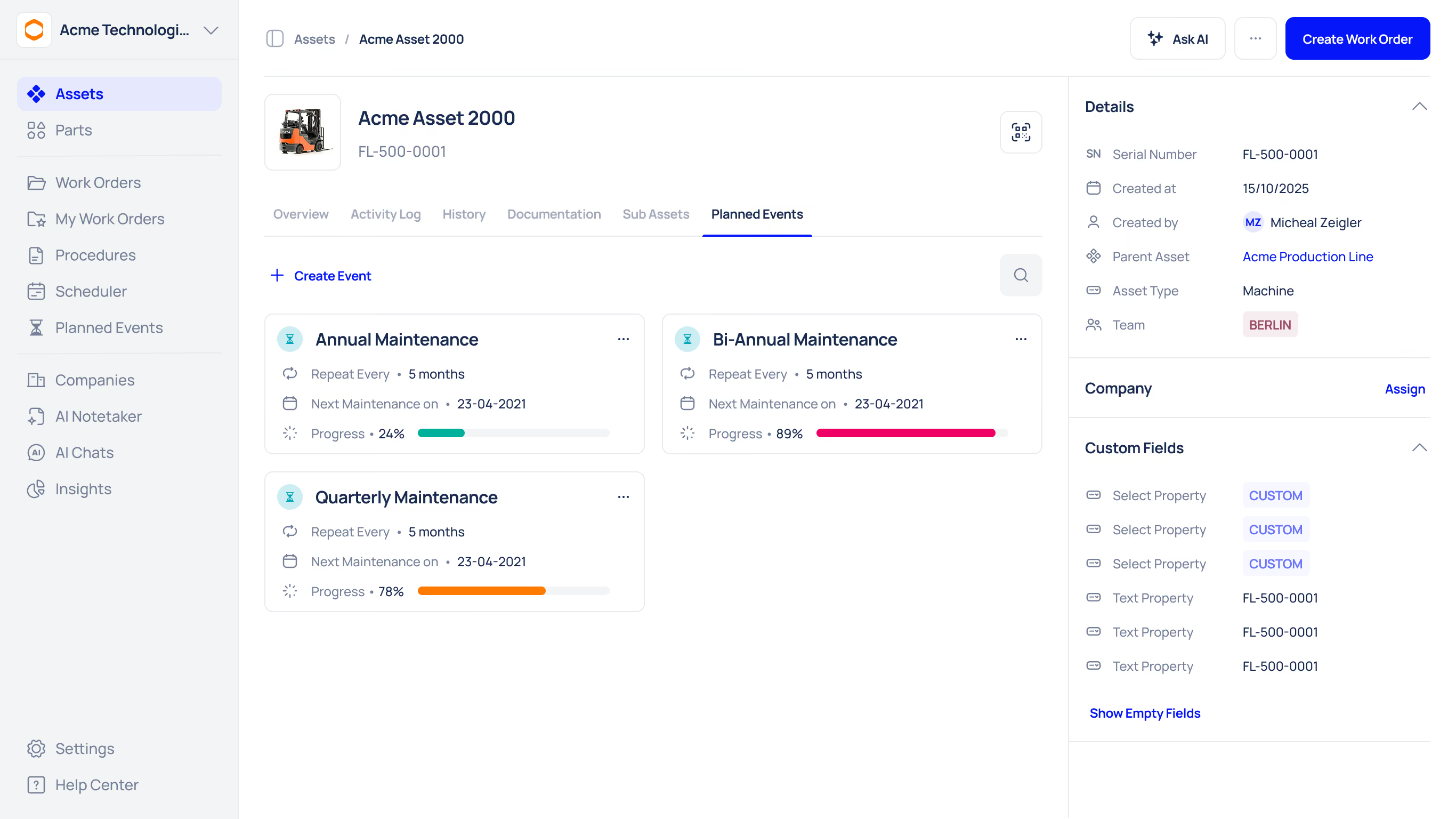
When to use: Assets with predictable wear patterns, where OEM intervals or long experience support calendar or run-hour-based PMs.
Practical example: Replace HVAC filters every three months; change pump packing at 6-month intervals; perform belt tension checks weekly.
Pros
- Predictable scheduling and parts planning.
- Simple to track in a CMMS.
- Reduces some classes of unexpected failures.
Cons
- Risk of over-maintenance if intervals are too conservative (waste of labour/parts).
- Scheduled downtime still stops production.
- Not data-driven — may miss issues that occur between intervals.
Implementation tip: Use PMs for lower-to-medium critical assets and as a baseline while you mature sensor programs for higher-value equipment. Track PM compliance and review intervals periodically to avoid PM creep.
3) Predictive Maintenance (PdM) — Condition-Based Maintenance
Definition: Predictive maintenance uses condition signals (vibration, temperature, oil analysis, electrical signatures) and analytics to predict failures and perform maintenance only when needed.
When to use: High-value or critical assets where the failure cost is high and where sensors and data analytics are feasible.
Practical example: Vibration sensors on critical bearings flag increasing kurtosis; work order auto-creates, and bearing replacement occurs just before catastrophic failure.
Pros
- Minimises unnecessary maintenance.
- Reduces unplanned downtime by detecting issues early.
- Better spare-parts optimization and planning.
Cons
- Requires investment (sensors, data platforms, analytics skills).
- Needs a maturity path — data quality, baselining, and thresholds are work to establish.
Impact: Studies and vendor analysis indicate predictive approaches can reduce unplanned downtime by 30–50% and yield maintenance cost reductions often in the ~10–40% range versus reactive programs, with quicker ROI when applied to high-dollar assets.
4) Prescriptive / Reliability-Centred Maintenance (RCM) — Proactive
Definition: Reliability-Centred Maintenance (RCM) is a process to determine the most effective maintenance approach for each asset based on failure modes and consequences. Prescriptive maintenance uses predictive analytics + AI to recommend the optimal action at the optimal time.
When to use: Mission-critical systems where failure consequences are severe (safety, production loss, regulatory or environmental impact).
How RCM works (high level):
- Identify asset functions and failure modes.
- Assess the effects and consequences of failure.
- Select applicable maintenance tasks (time-based PM, condition monitoring, redesign, run-to-failure, etc.).
- Implement and monitor results; iterate.
Practical example: For a gas turbine, RCM analysis might show that some components require time-based replacements, bearings need condition monitoring, and some noncritical sensors can be left to run-to-failure with spares available.
Pros
- Asset-specific, risk-based optimisation.
- Maximises uptime and minimises lifecycle cost.
- Aligns maintenance closely with business risk.
Cons
- Requires cross-functional expertise (engineering, maintenance, operations).
- Time and effort to perform thorough RCM analyses; prescriptive models need mature data.
Authoritative framing: RCM is widely accepted as the structured way to decide the right maintenance approach for each asset rather than applying a single policy across the plant. See defence/space/facilities guidance and RCM guides from industry sources for established methodologies.
Strategy comparison table
Choosing the right combination
There’s no single “best” maintenance strategy for an entire plant. The pragmatic approach is:
- Classify assets by criticality (safety, production impact, cost of failure).
- Apply RCM for high-criticality assets to determine whether time-based, condition-based, or prescriptive approaches are best.
- Use preventive routines for predictable, medium-critical assets.
- Reserve reactive for low-cost, redundant items.
- Gradually scale PdM: start with the highest-ROI assets (motors, bearings, compressors) to prove value.
A risk-based mixed model gives you the reliability of PdM or RCM where it matters and the simplicity of PM or reactive approaches where it doesn’t.
Practical templates & examples
Below are copy-and-use templates and a short case scenario.
a) PM schedule template (simple)
- Asset: Air compressor 1
- Frequency: Monthly visual inspection; Quarterly oil analysis; Every 12 months, replace hoses
- Task owner: Technician team B
- Parts: Spare hoses (2), oil filter (1)
- Notes: Trigger predictive vibration check if running hours exceed 1,200/month.
b) PdM trigger example (logic)
- Sensor: Bearing vibration RMS
- Baseline: 2.5 mm/s RMS normal range
- Warning threshold: >4.0 mm/s → schedule inspection (work order)
- Alarm threshold: >6.5 mm/s → urgent repair/stop
c) RCM decision snippet (flow)
- Identify failure mode → 2. Assess consequence → 3. Can we detect the condition?
- Yes → Consider PdM
- No, but predictable → PM
- Low consequence → RTF
- Yes → Consider PdM
d) Mini case study (illustrative)
A mid-sized food processing plant implemented PdM on 10 high-use mixers (vibration + temperature). After 12 months, they reported a ~30% reduction in unplanned downtime for those mixers and smoother spare parts planning. (This aligns with published PdM impact ranges.)
Glossary
Maintenance strategy: The high-level approach to how assets are maintained (policy + tactics).
Preventive maintenance (PM): Scheduled tasks at fixed intervals to prevent failure.
Predictive maintenance (PdM) / Condition-Based Maintenance (CBM): Actions triggered by condition signals (sensor data/analysis).
Reactive / Run-to-Failure (RTF): Repair after failure; acceptable only for low-impact assets.
Reliability-Centred Maintenance (RCM): A structured methodology to determine optimal maintenance tasks per failure mode.
Downtime: Period when the asset is unavailable; can be planned (scheduled) or unplanned (fault).
Low-maintenance design: Equipment engineered to require minimal routine upkeep.
CMMS: Computerised Maintenance Management System – used to plan, schedule and track maintenance work.
Work order: A CMMS record defining a maintenance task, responsible party, and parts/labour required.
Why preventive maintenance is the pragmatic choice for most plants
For most industrial facilities, a disciplined, time-based preventive maintenance (PM) program delivers the fastest, most predictable return on investment. Preventive maintenance reduces emergency repairs, makes staffing and parts usage predictable, and creates the audit trail and operational discipline that engineering teams need before investing in advanced analytics or sensor platforms.
Why pragmatic plant leaders choose preventive maintenance now
- Predictable operational cost. Time-based PMs allow planned labour allocation and parts procurement — reducing overtime, rush shipments and contractor premiums.
- Fast, measurable reliability wins. Organisations typically see meaningful reductions in unplanned failures within 3–6 months after consistent PM enforcement.
- Lower technical barrier. PMs require standard operating procedures and a CMMS — not an IoT stack or data science team. That makes them an accessible first step for plants of all sizes.
- Foundation for advanced programs. Clean PM execution produces the usage and failure records that make future predictive or RCM pilots reliable and lower-risk.
How Makula CMMS accelerates PM outcomes
- Rapid PM creation and deployment (bulk templates + repeatable checklists).
- Mobile work orders and step-by-step checklists that improve technician compliance.
- Parts linking and simple inventory tracking so PMs don’t stall waiting for spares.
- Clear compliance and audit reports — managers can demonstrate PM completion and track trends without spreadsheets.
Short framing for a board/ops audience: “Start with a robust preventive program to stop the biggest, lowest-effort leaks. Use the operational maturity and data you build in Makula to justify and de-risk any future predictive or RCM investments.”
ROI snapshot (one-page for decision makers)
Conservative, practical KPIs to measure value in the first 90–180 days:
- KPI 1 — % PM Compliance: Target ≥ 90% scheduled PM completion within 90 days.
- KPI 2 — % Unplanned Downtime Reduction: Conservative target = 15–30% reduction on covered assets within 3–6 months.
- KPI 3 — Emergency Repair Hours Saved: Track monthly reduction in overtime/contractor hours and convert to $ savings.
Executive summary metric example: Replace spreadsheet-based PMs with Makula → PM compliance rises to 90% → emergency callouts drop 20% → contractor/overtime spend reduces proportionally (quickly funds the Makula rollout).
Conclusion
Preventive maintenance is the pragmatic, high-impact starting point for most plants. By replacing ad-hoc work and spreadsheets with a disciplined, time-based PM program you gain predictable labor and parts planning, rapid reliability wins (typically visible within 3–6 months), and the clean operational records that make future predictive or RCM investments far less risky.
For engineering and maintenance leaders, the recommended path is simple and measurable:
- Classify assets by criticality and pick a focused pilot (20–50 assets).
- Deploy time-based PMs with repeatable checklists and parts linkage so techs execute work consistently.
- Measure the basics — PM compliance, unplanned downtime and emergency repair hours — and show the early ROI.
- Scale and iterate, using PM history as the foundation for any later PdM or RCM initiatives.
Makula CMMS is designed to accelerate this path: rapid PM creation, mobile checklists for technicians, parts management to avoid delays, and clear compliance reporting so operations can prove value quickly. If your goal is reliable uptime without heavy IoT investment today, preventive maintenance implemented via Makula is the fastest, lowest-risk route to measurable improvement.