Managing a modern manufacturing facility is a task of immense complexity. Gone are the days when equipment could be managed with simple lists or manually updated spreadsheets. In today’s factories, a single production line can be made up of hundreds of interconnected machines and subsystems. Each of these components, from major plant equipment to the smallest replaceable part, plays a critical role in the smooth operation of the whole. When maintenance teams lack visibility into these intricate parent-child equipment structures, tracking faults and understanding system dependencies becomes an almost impossible challenge.
This is where dedicated asset hierarchy software comes into its own. Rather than facing a disjointed sea of equipment names or sifting through endless lines of data, your team benefits from a unified, visual map of all plant assets and their relationships. This clarity brings efficiency, safety, and confidence to day-to-day plant maintenance and long-term strategy alike.
See Visual Asset Hierarchy in Makula CMMS
Discover how modern manufacturing teams move beyond flat asset lists and spreadsheets by using a visual, parent-child asset hierarchy. Learn how Makula helps you map every machine, subsystem, and component into a structured digital model that reflects your real plant, improving fault diagnosis, reducing downtime, and making dependencies instantly visible to your maintenance teams.

Overcoming Complex Equipment Structures
Consider the engineering that goes into something as large as an industrial press. It is not just a single machine; it's an assembly of hydraulic units, control computers, power panels, interlocked safety sensors, and various replaceable subassemblies. When a fault occurs perhaps a sensor issue or a leaking valve it is not always obvious which part is at fault, how taking something offline may impact production, or which other machines may be affected due to hidden dependencies.
Flat equipment lists force technicians to hunt for information, leading to confusion and costly errors. Teams spend too much time digging through manuals, misidentifying parts, or inadvertently shutting down other machinery due to disruptions upstream or downstream. These delays not only waste time but can also put significant production deadlines and safety standards at risk.
Visibility is essential. If technicians and managers cannot see at a glance how every component fits together, troubleshooting slows to a crawl. Poor understanding of child and parent relationships between assets leads to longer downtimes and makes preventative maintenance planning nearly impossible. This is why leveraging robust asset hierarchy software is not just helpful; it is vital.
The Power of Visual Asset Mapping
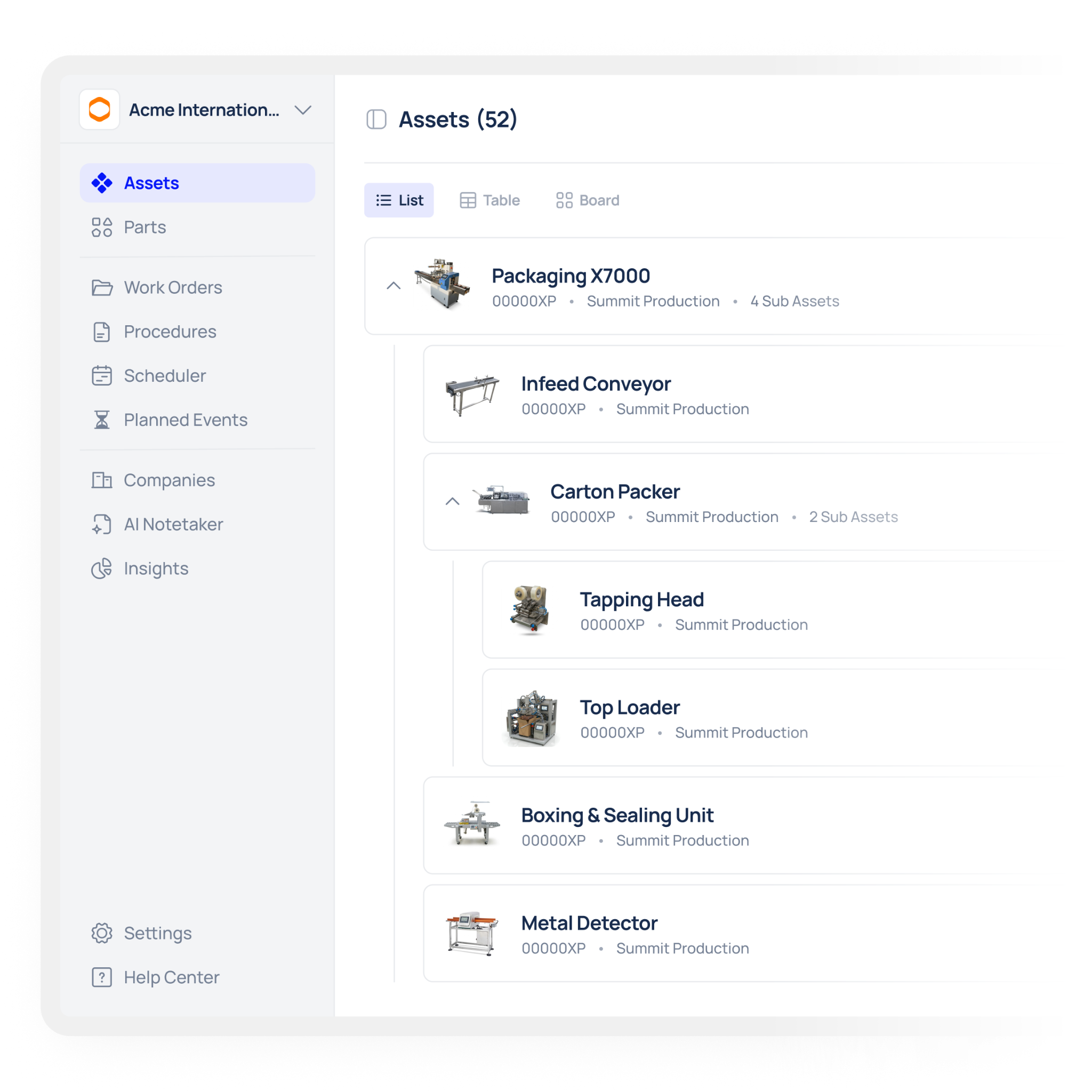
Imagine being able to view your plant as a living map starting from the highest-level facility, drilling down into production zones, pinpointing a specific line, and then seeing all its major machines, each showing a breakdown of every child component, their maintenance status, and dependencies. Visual asset mapping enables this level of insight.
When a maintenance engineer scans a QR code or enters a fault, they don’t just see an isolated component; they see its context: which bigger machine it belongs to, where it sits on the line, which systems it feeds into, and what will be affected by its downtime. Managers use this visibility to more effectively plan routine servicing, coordinate repair teams, and ensure critical components are never overlooked.
Furthermore, visualising dependencies prevents costly mistakes, such as powering down a pump without considering the impact on an attached cooling system or product quality monitor. It empowers staff to bring the right spares, not just guess and hope, driving significant savings in both labour and parts usage.
Makula helps you achieve these outcomes, giving your team an intuitive view of how every piece fits together through a structured, interactive digital hierarchy that mirrors your physical plant. This makes onboarding new staff easier, streamlines audits, and massively improves fault response times.
From Flat Lists to Intelligent Asset Structures
The difference between outdated flat listings and visual hierarchy solutions can be dramatic. Refer to the table below to see why moving to an advanced asset view is a step-change for manufacturing operations.
Flat lists hide essential asset context, leaving teams in the dark and increasing the risk of overlooked or repeated problems. In contrast, a dedicated hierarchy approach ensures that nothing is missed, even as plant layouts evolve and new machinery is introduced.
Unlocking Additional Benefits with Hierarchical Management
By moving beyond flat records and embracing hierarchy, facilities gain a wide range of operational advantages. Historical data can be layered for every sub-asset, highlighting trends in failures or revealing recurring weak points ripe for preventative maintenance. Energy or material usage can be traced along entire production chains, driving sustainability and cost-saving initiatives.
Hierarchies can also be aligned with compliance efforts. Regulatory checks, health and safety inspections, and asset-specific protocols are seamlessly tracked at every level of the plant structure. This transparency supports audit-readiness, keeps certifications up to date, and makes it simple for managers to demonstrate robust oversight.
Many organisations also use the visual hierarchy to streamline capital investment decisions, as they can identify which lines or components most frequently cause unplanned downtime, building a stronger case for equipment upgrades or process improvement projects.
Frequently Asked Questions (FAQs)
What exactly is a parent-child equipment structure?
A parent-child structure means linking smaller components (the children) to their main machine (the parent). For example, a heavy-duty forklift is the parent asset, while its battery and hydraulic lifting forks are the child assets. This mirrors the real-world dependencies in manufacturing.
Can we map equipment across different factory locations?
Absolutely. A robust hierarchy solution allows you to build relationships from a global view down to the smallest subcomponent. You can map assets by country, city, specific building, factory floor, production line, and right down to an individual sensor, ensuring total clarity at every level.
How difficult is it to build these complex relationships?
Modern platforms make this process straightforward. There is no need for specialist coding. Assets can be created, linked, and nested via intuitive drag-and-drop interfaces or quick forms. Makula, for example, supports bulk uploads and flexible data structuring, so evolving your plant map takes minutes, not days.
What if we make changes to our equipment or layout? Do we need to start from scratch?
Not at all. Hierarchies are designed for change. You can quickly edit, move, or relabel assets as your plant grows or reconfigures, ensuring your digital records always reflect reality.
Take Control of Your Equipment Data
Without clear visibility, even the most experienced maintenance teams are forced into guesswork. Flat lists and basic databases actively hide the connections and dependencies that are essential for resolving faults efficiently and planning effective preventative maintenance.
Transitioning to intelligent asset structures changes everything. By mapping every asset, relationship, and location, your team is empowered to act fast, reduce risks, and keep production lines moving. You eliminate wasted searches, support better compliance, and bring new staff up to speed with far less training required.
Makula delivers the solutions you need to visualise, manage, and optimise your operations through an asset hierarchy tailored for the demands of complex manufacturing.
Let our team guide you in building your parent-child asset tree during a live demonstration, using your real factory data to showcase the full transformational impact.
Explore the hierarchy view today and experience the future of asset management for complex manufacturing assets.