%20Maturity%20Quiz%20Are%20Your%20PMs%20Working%20(1).avif)
You dispatch technicians every week to grease bearings, change filters, and inspect belts. The team diligently ticks every box on the schedule. Yet, unexpected breakdowns still disrupt your production line. This frustrating cycle leaves operations managers grappling with a difficult realisation: "We don't have a way to score PM effectiveness."
Doing preventative maintenance (PM) simply because a manual says so is no longer enough. If you cannot prove that your routine tasks directly prevent machine failures, you are likely wasting valuable labour and expensive spare parts. To fix this, you need a clear framework to evaluate your strategy.
This is where a PM maturity assessment comes into play. By scoring how you plan, execute, and measure maintenance, you can identify exactly which tasks protect your bottom line and which ones merely create busywork.
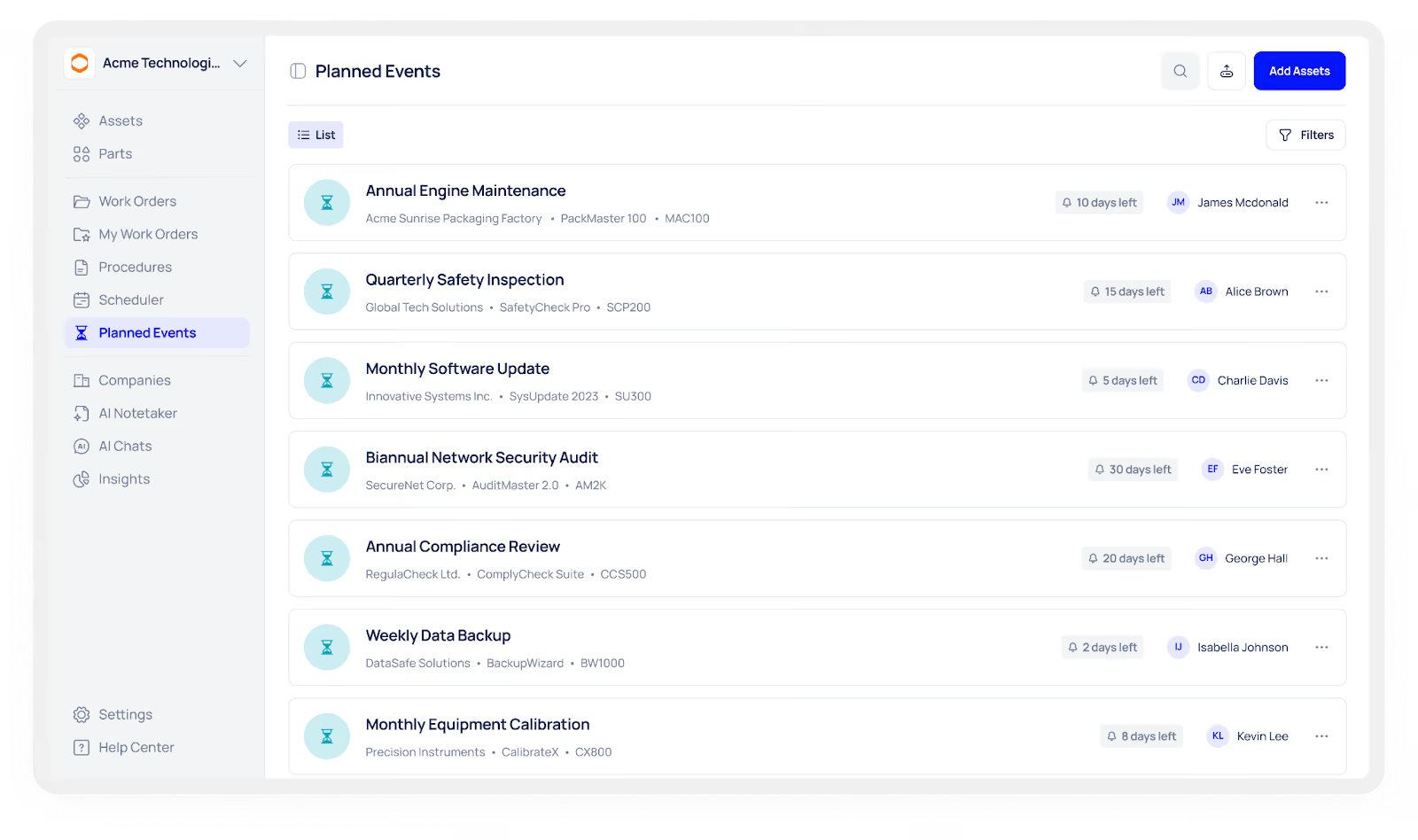
In this guide, we will explore the different stages of maintenance maturity, how to evaluate your current operations, and provide a framework to stop guessing and start measuring.
The invisible cost of unscored maintenance
Why do so many facilities struggle to measure PM effectiveness? The root cause is usually a reliance on completion rates as the only metric of success. If a technician finishes all their assigned tasks for the month, the maintenance planner marks it as a win.
However, completion does not equal effectiveness. When you lack a proper PM maturity assessment, several hidden costs begin to drain your budget:
- Routine over-maintenance: You replace components that still have months of viable life left, simply because a calendar dictates the intervention.
- Wasted technical labour: Highly skilled technicians spend hours on low-value, repetitive inspections instead of focusing on critical root-cause analysis.
- The illusion of reliability: You believe your facility is protected because the PM schedule is full, leaving you completely unprepared when a catastrophic breakdown inevitably occurs.
To break free from this cycle, you must shift your focus from simply doing the work to measuring the impact of the work.
What is a PM maturity assessment?
A PM maturity assessment is a strategic evaluation tool. It looks beyond basic completion metrics and analyses the underlying intelligence of your maintenance programme.
Instead of asking, "Did we do the PM?" an assessment asks harder questions. "Did this PM prevent a failure?" "Did we perform this task at the right time?" "Did we base this intervention on real machine data or a static calendar?"
By answering these questions honestly, you can plot your facility on a maturity curve. This curve helps you understand whether your operations are entirely reactive, blindly scheduled, or intelligently driven by actual equipment conditions.
The four stages of PM maturity
To understand how to score your effectiveness, you must first understand the four distinct stages of maintenance evolution. Most manufacturing facilities find themselves stuck between stages two and three.
Stage 1: Reactive firefighting
At this lowest stage of maturity, preventative maintenance is practically non-existent. You fix machines only after they break. There is no schedule, no planning, and no measurement. Labour costs are highly volatile, and production schedules are constantly interrupted.
Stage 2: Calendar-based compliance
This is where many companies plateau. You have a PM schedule, but it is entirely driven by static dates. You service a conveyor belt every 30 days, regardless of whether it ran for 10 hours or 100 hours that month. While this is better than pure firefighting, it is highly inefficient. A PM maturity assessment will quickly highlight massive gaps in resource allocation at this stage.
Stage 3: Usage-based intelligence
At this stage, your maintenance interventions are triggered based on actual machine usage. You measure operating hours, production cycles, or mileage. You only spend money servicing equipment when it has definitely earned that service through hard work. This stage requires accurate data collection and a reliable system to track metrics across the shop floor.
Stage 4: Predictive optimisation
The highest tier of maturity involves condition-monitoring sensors and advanced data analytics. You perform maintenance exactly when an asset shows early signs of degradation, such as abnormal vibration or temperature spikes. You achieve maximum uptime with minimal wasted effort.
How to score your current effectiveness
Scoring your PM effectiveness requires mapping your routine tasks against your reactive breakdowns. If a specific machine receives regular preventative maintenance but still suffers from frequent unplanned downtime, your PMs for that asset are highly ineffective.
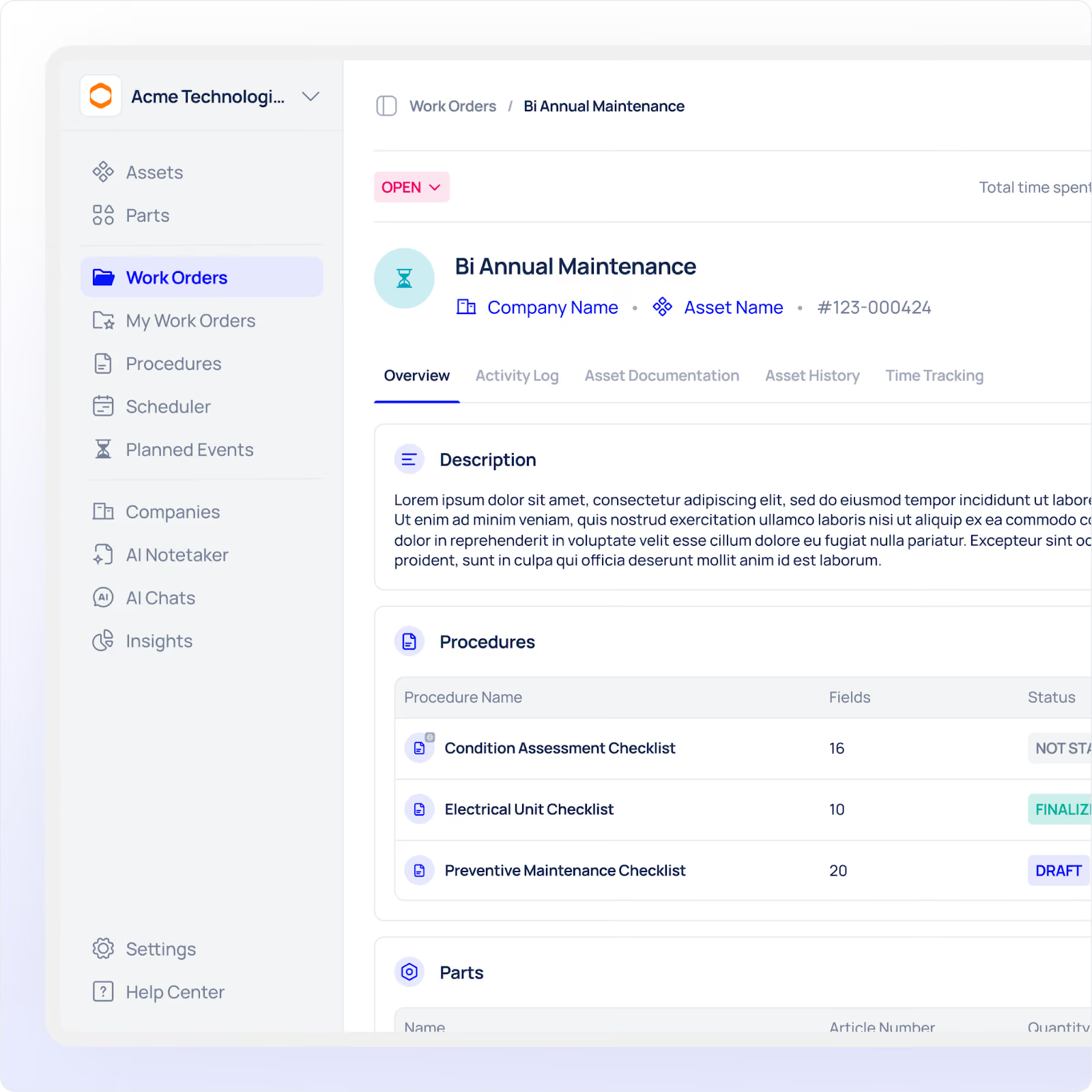
To successfully track this, you need a unified data environment. Using a modern platform like Makula CMMS allows you to easily cross-reference your PM completion logs with your reactive fault tickets. When you overlay this data, the truth becomes undeniable. You can instantly spot which scheduled tasks actually correlate with improved reliability, and which ones are useless.
Once you have this visibility, you can confidently delete redundant tasks, stretch intervals for over-maintained assets, and reallocate your workforce to high-value projects.
Key indicators of your PM maturity
To help you visualise where your facility currently stands, review the summary table below. It outlines the key indicators across different levels of maintenance maturity.
Conclusion
Preventative maintenance is only as effective as your ability to measure its impact. Without a structured PM maturity assessment, even diligently completed tasks can waste labour, spare parts, and time, while leaving your operations vulnerable to unexpected breakdowns.
By understanding your current stage, from reactive firefighting to usage-based or predictive optimisation, you can identify gaps, optimise schedules, and focus resources on the maintenance activities that truly improve reliability. A digital platform that centralises PM data and tracks outcomes makes this process faster, more accurate, and easier to act on.
The next step is clear: evaluate your PM maturity, eliminate redundant tasks, and adopt a smarter, data-driven maintenance strategy that maximises uptime, extends asset life, and ensures every technician’s effort delivers measurable value.