It’s 2:00 PM and production stops, again
Critical Asset #4 has just ground to a halt. The maintenance engineer opens the storeroom, scans the shelf where the replacement motor should be… nothing but dust. Panic. A call to the supplier. “I need this motor now, overnight.” The machine is fixed the next morning, but three weeks later the invoice arrives: the shipping fee alone is triple the part price.
This isn’t a one-off. When overnight courier fees become the default solution, you’re paying a permanent “panic tax.” The good news: a CMMS configured the right way, like Makula CMMS, removes the panic and the cost.
The hidden price of panic
Expedited shipping is the visible bill. The true cost is broader:
- Premium unit pricing — rushed orders often cost more than standard purchases.
- Administrative chaos — urgent POs, procurement re-prioritised, and manual paperwork.
- Logistical waste — single-box courier runs instead of consolidated shipping.
- Downtime cost — lost production while waiting for parts.
Over a year, these “small” costs compound into a serious budget leak.
Why does the shelf stay empty?
If a part is critical, why isn’t it stocked? Common failures, and how Makula fixes them.
1. Ghost inventory
Parts are taken but not logged. If engineers skip logging because the system is hard to reach, automated reorder thresholds never trigger.
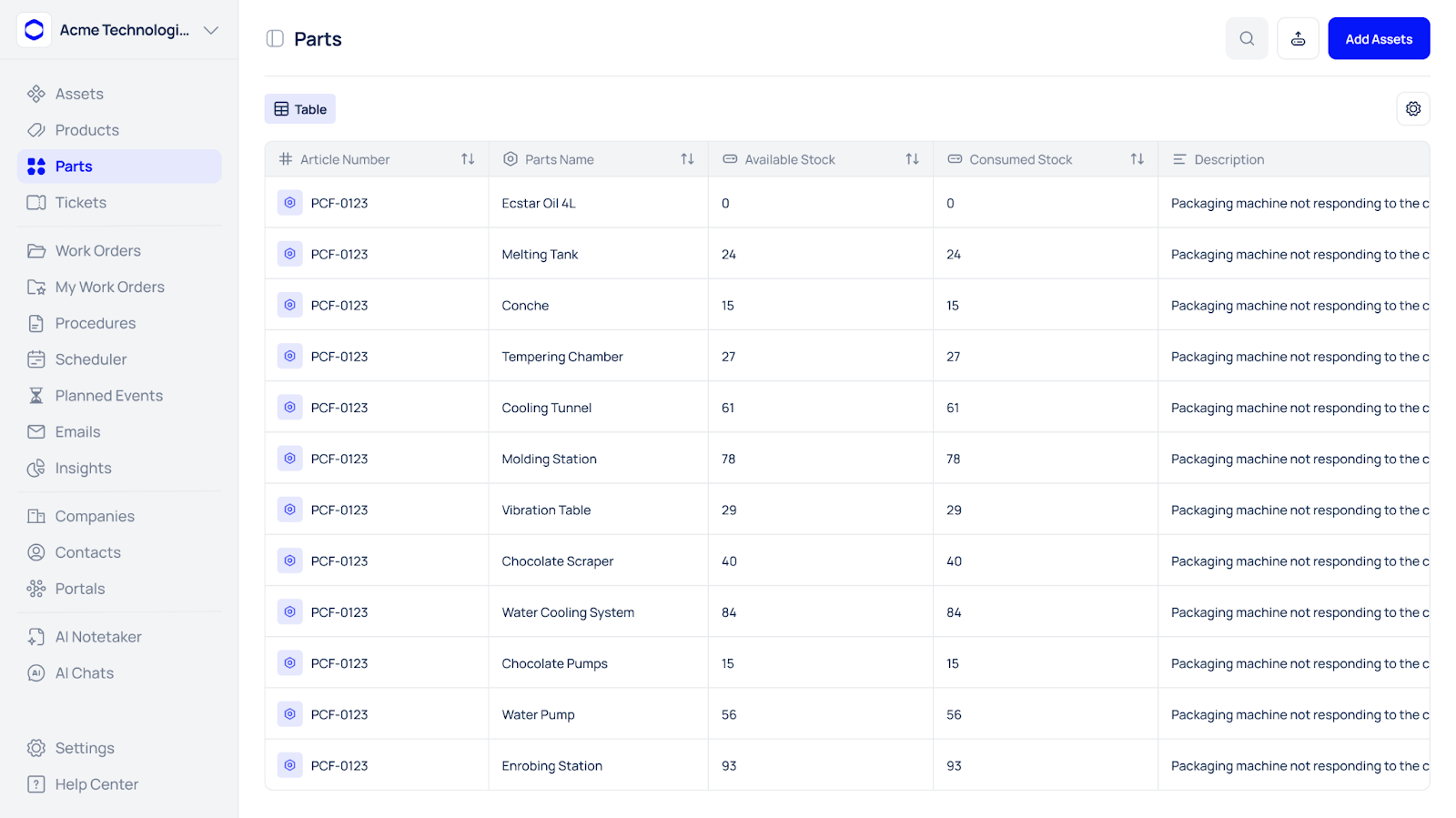
Makula fix: mobile barcode scanning and simple bin checkout keep counts accurate in real time, so your digital stock matches the shelf.
2. Reactive reordering
Whiteboards and notepads rely on memory and luck. Reordering usually happens during breakdowns.
Makula fix: use automatic min/max levels and vendor re-order rules so replenishment happens on schedule, not during an emergency.
3. Fear of overstocking
Finance pressures cut stores to “lean” levels, but blind JIT for maintenance can mean “Just-Too-Late.”
Makula fix: criticality analysis in Makula lets you protect spares for high-impact assets while trimming low-value stock, optimisation, not hoarding.
Panic vs. Control — comparison
How Makula CMMS stops overnight parts costs
Inventory accuracy & easy logging
- Mobile barcode scanning at the bin: technicians scan parts with a phone, instantly logging usage. No walk to a PC, no missing transactions.
Automated reorder rules
- Set minimum and maximum stock per SKU; Makula triggers POs or purchase suggestions before you hit the danger zone.
Critical spares tagging & dashboards
- Tag high-criticality spares. Dashboards show kit health, stockouts, and lead times so managers can act before a breakdown.
Vendor & PO automation
- Store preferred vendors, lead times and pricing. When a reorder triggers, the right supplier and shipping method are selected automatically.
Consumption reporting & forecasting
- Usage trends expose which parts are true wear items and which are infrequent. Use this to reduce dead stock while keeping the real critical spares on-hand.
PM integration (time-based)
- Makula’s time-based PM schedules predict parts consumption for routine tasks so you replenish ahead of planned maintenance windows.
Note: Makula currently focuses on time-based preventive maintenance and comprehensive inventory & workflow automation. If you require meter-based triggers or IoT sensor integrations, call us — we can advise on best-fit approaches and integrations with third-party systems.
Action plan: 6 steps to stop paying the panic tax (do this in 30 days)
- Identify critical spares — run a criticality matrix (lead time × asset criticality). Mark 10–25 high-impact SKUs.
- Set min/max levels — use historical usage from Makula to set practical thresholds.
- Deploy mobile scanning — place barcode labels on bins and equip techs with the Makula mobile app.
- Enable automated reorders — configure vendor rules and reorder approvals for low friction.
- Run a cycle count — complete a single audit to reconcile ghost inventory and correct counts.
- Monitor & improve — review the Makula dashboard weekly; revise thresholds for seasonal usage.
Quick ROI example — arithmetic shown clearly
Small example to show how quickly savings appear.
Assumptions:
- Current annual emergency shipping incidents: 24
- Average expedited shipping fee per incident: $150
Calculation (digit-by-digit):
- 24 incidents × $150 = (24 × 100) + (24 × 50) = 2400 + 1200 = $3,600 per year before improvements.
- After Makula controls, incidents fall to 5 per year. 5 × $150 = (5 × 100) + (5 × 50) = 500 + 250 = $750.
- Annual saving = 3600 − 750 = $2,850.
- That's a reduction of about 79.17% in emergency shipping spend.
If your average part cost or incident rate is higher, the savings scale accordingly — and that doesn’t count reduced downtime, fewer urgent POs, or lower admin hours.
Customer: “After we deployed Makula and set min/max levels for 15 critical spares, our overnight couriers dropped 80% in 3 months. Inventory visibility paid for the subscription within six months.” — Maintenance Manager