Most AI tools look impressive in a polished demo.
The dashboard is clean. The data is perfect. The answers sound fast and confident.
But maintenance teams do not work in perfect conditions.
Your engineers write short notes. Fault descriptions are messy. Asset names are abbreviated. Some jobs are detailed, while others are barely documented at all. That is exactly why testing an AI copilot on your real maintenance jobs is the only reliable way to judge whether it will actually help your team.
If the software cannot handle your own work orders, engineer notes, and fault codes, it will not deliver the value you need after implementation.
Why generic AI demos are not enough
A generic demo is designed to show the best-case scenario.
Real maintenance operations are different.
That gap matters. A tool that performs well in a controlled setting may struggle the moment it meets real maintenance data.
What a real-job test should prove
A proper AI copilot test should answer one question:
Can this system understand the way our team actually works?
To prove that, the copilot should be tested on:
- job descriptions written by engineers
- fault codes
- asset names
- repair notes
- parts used
- time taken to complete each job
A one-week sample is usually enough to show whether the AI can interpret real maintenance data and produce useful suggestions.
See How AI Copilot Performs on Real Maintenance Jobs
Discover why polished AI demos are not enough—and how real-world maintenance data changes everything. See how Makula helps teams test AI copilots on actual work orders, messy engineer notes, fault codes, and repair history to understand whether the system truly works in day-to-day operations.

Why is one week of jobs enough
You do not need years of history to make a good decision.
One week of jobs can reveal:
- whether the AI understands your terminology
- whether it can work with messy notes
- whether it recognises repeat faults
- whether it gives relevant suggestions
- whether it can support faster diagnostics
That makes the test simple, focused, and decision-ready.
What to look for during the evaluation
The real value is not just in seeing an answer. The value is in seeing whether the answer helps your team work faster and with more confidence.
If the copilot performs well in these areas, it is much more likely to deliver value in day-to-day maintenance.
What real maintenance data often reveals
When teams test AI on actual work orders, they often discover hidden issues in their own processes.
For example:
- The same fault is described in multiple ways
- recurring jobs are not clearly linked
- Engineer notes are too short to reuse
- Repeat breakdowns are not visible
- Some fixes are trapped in people’s memories
That is valuable because it does not just test the software. It also exposes where your maintenance knowledge is being lost.
Why this matters for Makula CMMS
This is where Makula CMMS becomes relevant.
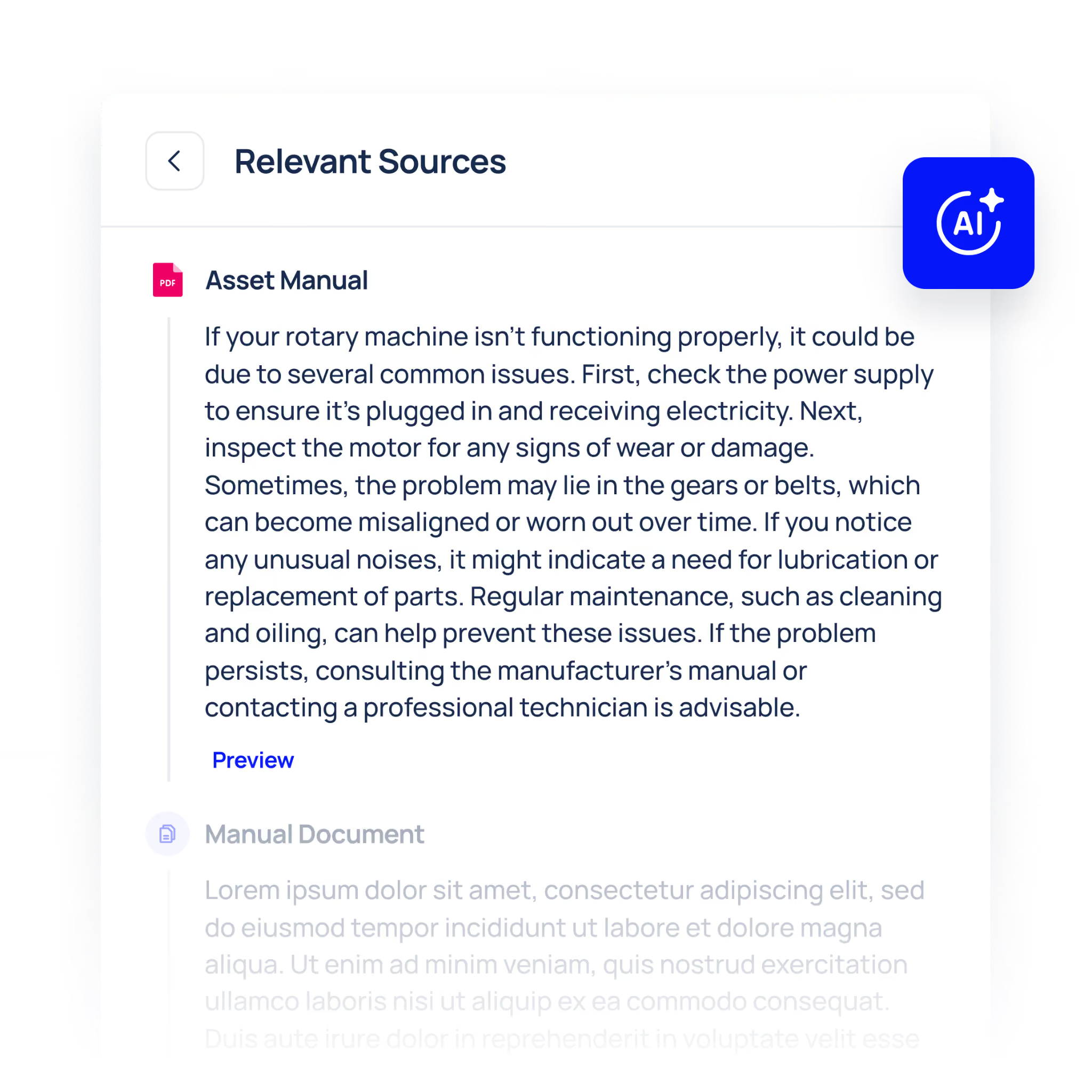
A good maintenance platform should help teams work from their own data, not force them into generic templates that ignore how they actually operate.
Makula helps you keep work orders, repair notes, and asset information in one place so knowledge does not disappear after a job is closed. That makes it easier to:
- search past repairs
- identify repeat faults
- reduce diagnostic time
- ? maintenance knowledge
- improve decision-making across the team
That is where the business value becomes clear.
The business case becomes stronger.
Once you see the copilot working on your real jobs, the conversation changes.
You are no longer asking whether AI sounds smart in theory. You are asking whether it can:
- reduce repeat diagnostics
- speed up troubleshooting
- help new technicians work faster
- make maintenance knowledge easier to reuse
- save time on common breakdowns
That is the kind of evidence leadership cares about.
What to do next
The best way to evaluate an AI copilot is simple.
Take one week of your actual maintenance jobs and see how the system handles them.
If it understands your notes, your faults, and your workflow, you will have a much clearer picture of whether it is worth adopting. If it does not, you have saved yourself time, cost, and implementation risk.
Final takeaway
Do not choose AI for maintenance based on a polished demo.
Choose it based on how it performs on your real jobs.
A one-week test can show you:
- how well the copilot understands your data
- whether its answers are useful
- how much time could it save your team
- whether it fits the way your maintenance operation actually works
That is the safest path to a better decision.
See how an AI copilot performs on your real maintenance jobs and find out whether it can deliver value for your team before you buy.