Most maintenance teams aren't short of activity. Work orders get raised, technicians complete tasks, and PMs get ticked off. The problem is that when a compliance officer walks in, or when a production director asks why Line 4 went down, the evidence often isn't there. Not because the work wasn't done but because the software couldn't prove it.
Preventive maintenance tracking software is supposed to solve that. But not all tracking capability is equal. There's a significant difference between a system that logs completed tasks and one that gives you a clear, auditable picture of what was done, when, by whom, and what was missed.
If you're at the stage of comparing platforms and narrowing down your shortlist, this guide is written for you. It won't tell you how to run a PM programme. It will tell you exactly what tracking and reporting capability to demand from any vendor you're evaluating so the platform you choose gives you visibility that holds up when it actually matters.
Here's what we'll cover:
- Why invisible PM completion creates risk beyond the shop floor
- The five tracking capabilities that separate audit-ready platforms from the rest
- What to look for in sign-off workflows and exportable records
- A side-by-side evaluation table for comparing vendors
- Questions to ask in a demo
When PM Completion Is Invisible, Everyone Pays
There's a particular type of risk that builds quietly in maintenance operations: the gap between what you believe has been completed and what you can actually prove.
A time-based PM schedule tells you when tasks are due. But without robust tracking, you have no reliable way to know whether those tasks were completed on time, completed late, partially completed, or skipped altogether. And if you can't see it, you can't manage it and you certainly can't defend it.
The consequences show up in two places. First, on the plant floor: assets that appear maintained on paper but aren't actually serviced on time are more likely to fail unexpectedly. Second, in the compliance environment: when an auditor asks to see maintenance records for a specific asset over a 12-month period, a spreadsheet or a loosely configured system won't give you that answer in minutes.
Regulated industries food and beverage, pharma, packaging don't have the luxury of approximate records. PM compliance tracking needs to be accurate, complete, and retrievable.
See What Audit-Ready Preventive Maintenance Tracking Looks Like
Discover how maintenance teams gain real-time visibility into overdue PMs, completion rates, asset history, and digital sign-offs. See how Makula helps you produce compliance-ready maintenance records in minutes, not hours.

Five Tracking Capabilities Every Buyer Should Demand
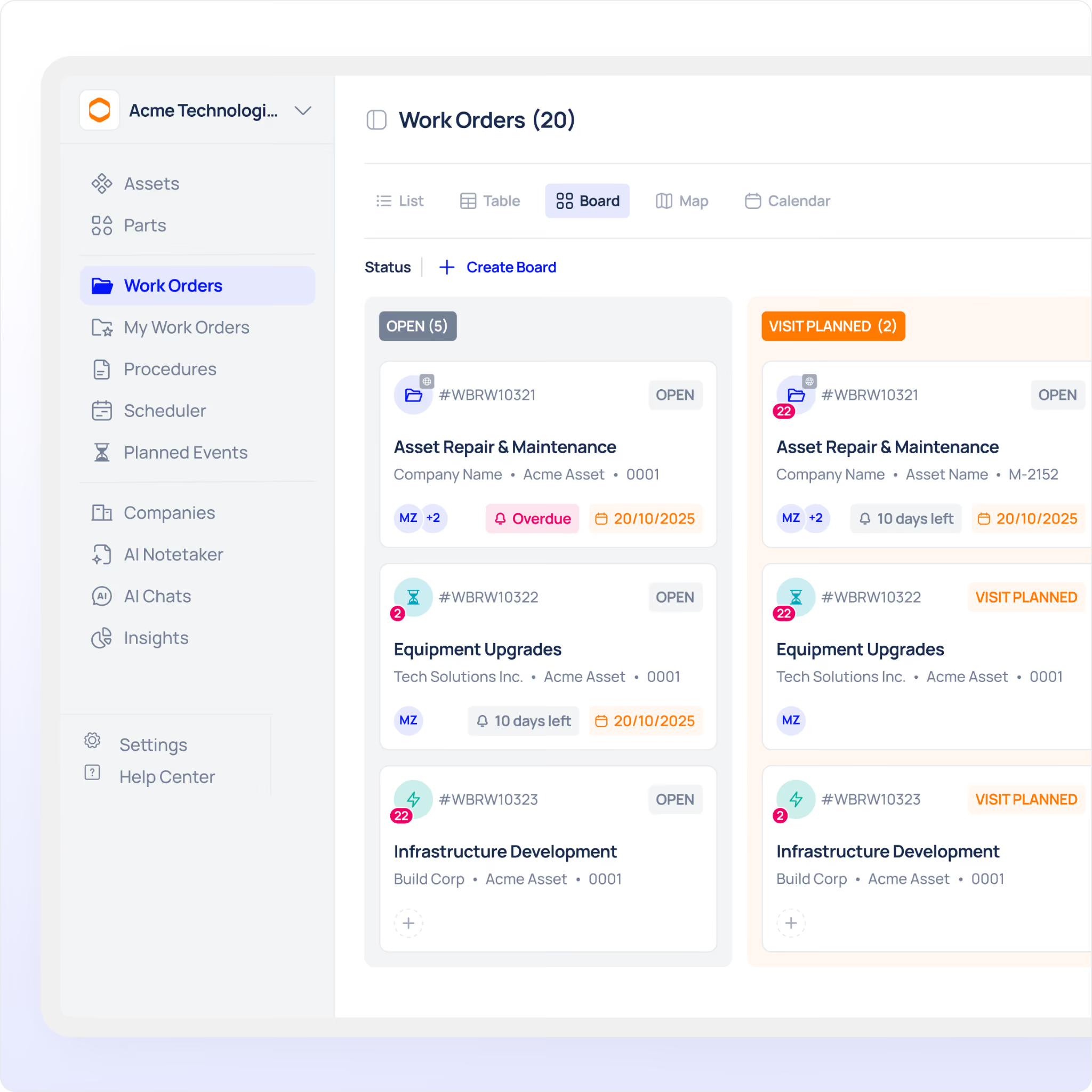
When evaluating preventive maintenance tracking software, these are the five areas where tracking quality genuinely separates platforms.
1. Real-Time Visibility Into Due and Overdue PMs
The most fundamental tracking capability is knowing, at any given moment, which PMs are due, which are overdue, and by how much. This sounds straightforward. In practice, many platforms bury this information in reports that require manual generation, or they present it in ways that are too aggregate to be useful.
What you should demand:
- A live dashboard showing due and overdue PMs across your entire asset base or filtered by line, area, or asset type
- Clear ageing of overdue tasks not just that a PM is late, but how late
- The ability to filter and drill down without needing to export data first
- Automatic escalation or alerts when PMs cross a defined overdue threshold
If a planner has to run a report to find out what's overdue, the information is already too slow to act on.
2. Completion Rate Tracking by Asset, Line, and Period
PM completion rate is one of the most meaningful indicators of maintenance programme health, and it's one of the first metrics a compliance auditor will ask about. You need to be able to see it at multiple levels of granularity: across the whole plant, broken down by production line, and at the individual asset level.
Look for:
- Completion rate metrics that update in real time, not just at the end of a reporting period
- The ability to compare completion rates across time periods (this month vs. last month, this quarter vs. the same quarter last year)
- Line-level or area-level breakdowns that help you identify systemic gaps rather than isolated misses
A platform that only shows you a single aggregate completion rate is hiding the detail you need to act.
3. Full Asset Maintenance History
Every asset in your facility should have a complete, chronological record of every PM that was scheduled, completed, rescheduled, or missed with no manual effort required to compile it.
This is not just useful for audits. It's essential for:
- Identifying assets with a pattern of late or skipped PMs before they cause a failure
- Supporting root-cause analysis when a breakdown occurs
- Demonstrating regulatory compliance for specific equipment over a defined period
When evaluating a platform, ask to see the asset maintenance history view for a single piece of equipment. It should show every scheduled PM, its actual completion date, who completed it, and any notes or observations recorded at the time. If pulling that record requires exporting data and formatting a spreadsheet, the platform has a significant gap.
4. Digital Sign-Off and Accountability Workflows
A completed work order is only as credible as the sign-off behind it. For compliance purposes, the question isn't just "was this done?" it's "who confirmed it was done, and when?"
Digital PM sign-off workflows create an auditable chain of accountability. What to look for:
- Technician sign-off at task completion, captured within the system with a timestamp and user identification
- Supervisor or manager review and approval for compliance-critical assets
- The ability to attach photos, notes, or readings as part of the sign-off process
- An immutable record sign-offs that cannot be edited after the fact without a clear change log
In regulated environments, a verbal confirmation or a paper signature scanned and filed elsewhere is not sufficient. The sign-off needs to live inside the system, linked directly to the work order and the asset.
5. Exportable Audit Records
All the tracking capability in the world is only useful if you can produce the records when you need them quickly, in a usable format, and without depending on a software vendor to generate a custom report for you.
Exportable maintenance audit records should be:
- Producible in minutes, not hours
- Filterable by asset, date range, PM type, and completion status
- Formatted to match what auditors and regulatory bodies expect to see
- Available as PDF or structured data export without needing developer support
Ask vendors directly: if an auditor arrived tomorrow and asked for all PM records for a specific production line over the past 12 months, how long would it take to produce that? The answer should be measured in minutes.
PM Tracking Software Evaluation: At a Glance
Use this table when comparing platforms during your evaluation process.
Common Weaknesses to Watch for During Evaluation
Vendors rarely volunteer their limitations. Here are the gaps most likely to surface after you've signed the contract rather than before.
Aggregate-only reporting. Some platforms show plant-wide completion rates but can't break them down by line or asset. This makes it difficult to identify where problems are actually concentrated.
No ageing on overdue tasks. Knowing a PM is overdue is useful. Knowing it's 14 days overdue on a safety-critical asset is urgent. Platforms that simply flag overdue status without ageing information leave you guessing about severity.
Sign-offs outside the system. Some platforms allow PMs to be marked complete without a proper sign-off workflow, relying instead on paper records or external tools. This creates a record-keeping split that will cause problems during an audit.
Slow or manual export processes. If producing an audit-ready report requires a data export, a spreadsheet build, and manual formatting, that process will fail under audit pressure precisely when you need it to work quickly.
What to Ask in a Demo
Bring these questions to any vendor demo to move past the standard walkthrough:
- Open the live PM dashboard and filter overdue PMs by line. How quickly can you see which specific tasks are overdue, on which assets, and by how many days?
- Show the asset history for a single piece of equipment. How many clicks does it take, and what level of detail is visible?
- Walk through a PM sign-off. Where is the timestamp recorded? Can the sign-off be edited afterwards, and if so, what record does that create?
- Export a compliance report for one production line. How long does it take, and what does the output look like?
- Show what a skipped PM looks like in the system. Is it clearly flagged, recorded, and included in completion rate calculations?
A platform that handles all of these without hesitation is one that was built for compliance. One that routes you back to feature slides is telling you something important.
Conclusion
Preventive maintenance tracking software earns its place not when everything is running smoothly, but when you need to prove it. The platforms that hold up under scrutiny are the ones built around visibility: real-time overdue status, full asset maintenance history, accountable sign-off workflows, and audit records you can produce in minutes not after a half-day of data preparation.
If your current system can't clearly show what's been done, what's overdue, and who signed off on what, it isn't giving you the visibility your operation needs.
Book a demo to open a live PM compliance dashboard, filter overdue PMs by production line, and see exactly what audit-ready tracking looks like in Makula before you make your final decision.