Picking maintenance software is hard enough on its own. But if you operate in Europe, there’s a second test most buyers don’t see coming: the moment your compliance team, your works council, or a customer’s procurement form asks a simple question: where does the data actually live?
That’s exactly where the usual “best CMMS” lists fall short. They rank US-built tools against US-centric criteria and never mention jurisdiction, GDPR, or NIS2 once. So we built this guide the other way around: starting from what European maintenance teams are actually held to, then matching the software to it.
Below, you’ll get a quick definition, the buying criteria that matter in Europe, an at-a-glance comparison, and a detailed look at the 8 best European CMMS platforms for 2026, what each one costs, what it’s best at, and where it falls.
Key takeaways:
- The “best” European CMMS depends on your use case: Makula for asset-heavy, audit-ready manufacturers; IFS Ultimo for enterprise EAM; osapiens for SAP shops; Infraspeak for facilities; Fracttal for IoT; Coswin 8i for on-premise control.
- For compliance, EU residency (where the servers are) is not the same as EU jurisdiction (which laws the vendor answers to). US-owned tools carry CLOUD Act exposure even when hosted in Frankfurt.
- Most European industrial teams run on time-based preventive maintenance, don’t overpay for predictive/AI modules you won’t configure.
- The best platform is the one your technicians will actually open. Trial it with real assets and real people before you buy.
What is a European CMMS (and why it matters)?
A European CMMS is a computerised maintenance management system built and operated under European rules, an EU-headquartered vendor, EU data residency, GDPR and NIS2 readiness, multi-language interfaces, and EU-based support, combined with the core maintenance fundamentals of work orders, preventive maintenance, asset history, and spare parts.
In other words, “European” isn’t a marketing badge. For a maintenance platform, it comes down to a few concrete things:
- Vendor jurisdiction. An EU-headquartered vendor is subject to EU law. A US-headquartered vendor, even one hosting your data in Frankfurt, stays reachable under the US CLOUD Act. For most non-regulated work that’s acceptable; for critical infrastructure, pharma, or public-sector contracts, it’s increasingly an audit finding.
- Data residency and hosting. EU-region hosting keeps processing under a single legal regime and removes the hardest cross-border-transfer questions.
- Regulatory fit. GDPR is the baseline, but 2026 buyers also navigate NIS2 (cybersecurity rules now reaching far more industrial operators), the EU Data Act (rights over IoT machine data), and DORA for financial-adjacent entities, plus sector overlays like HACCP/FDA records in food and pharma.
- Language and local service. German, French, Italian, Spanish, Dutch and more, for the technician on the floor, not just the admin console, backed by EU support hours and EU billing.
Pro tip: residency is not sovereignty. Storing data in an EU data centre owned by a US company satisfies residency but not sovereignty. If your compliance team has flagged “concentration risk” or “CLOUD Act exposure,” the vendor’s country of incorporation matters as much as the data-centre map.
See How European Manufacturers Choose the Right CMMS
Compare leading European CMMS platforms, understand the difference between EU hosting and EU jurisdiction, and see how manufacturers improve compliance, preventive maintenance, and technician adoption with the right maintenance software.

What to look for in a European CMMS
We evaluated every platform below against the same criteria, weighted toward what matters to a European maintenance or plant team:
- Data residency & compliance, EU jurisdiction, hosting options, certifications (e.g. ISO 27001), audit-readiness.
- Preventive maintenance depth, time-based (calendar/runtime/cycle), meter-based, and where offered, condition-based scheduling.
- Mobile & offline execution, can a technician complete and document a job from the floor, with or without signal?
- Deployment speed & adoption, time-to-value, and whether non-technical technicians will actually use it.
- Multi-site & multi-language, for operations spanning plants, countries, and languages.
- Integrations, ERP/SAP connectivity, IoT, and open APIs.
- Support & local presence, EU support, onboarding, and documentation.
- Pricing transparency, published rates vs. quote-only, and total cost over a 3–5 year horizon.
One thing we deliberately didn’t over-weight: “AI” and “predictive maintenance.” For most European industrial teams in 2026, disciplined time- and meter-based PM, clean asset history, and audit-ready records deliver more value than an analytics module that never gets switched on.
The 8 best European CMMS platforms in 2026
Here’s the shortlist at a glance, followed by a full breakdown of each tool.
* Indicative 2026 pricing. Vendors change plans frequently; confirm current pricing, EU billing, and data-residency terms directly before purchase.
1. Makula: best for asset-heavy European manufacturers
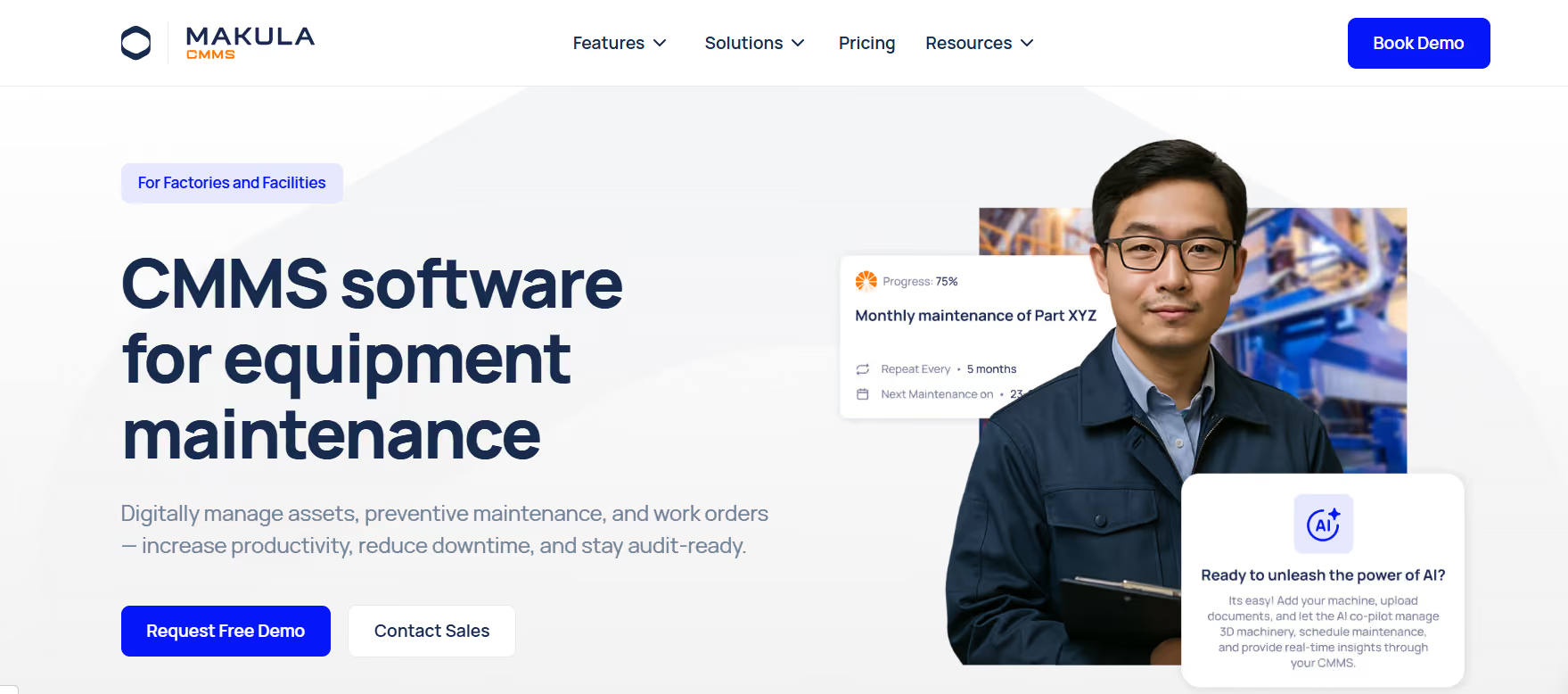
Makula is a Berlin-built, modular CMMS designed around one promise: the tool your maintenance team will actually open on Monday morning. It centralises work orders, preventive maintenance, asset history, and spare parts, with a mobile-first app technicians can use offline and via QR scanning. Its PM is time-based (calendar, runtime hours, cycle counts), exactly what most regulated production lines run on.
Best for: SME-to-mid-market manufacturers in food & beverage, packaging, pharma, chemical and industrial manufacturing that want dependable, compliant, EU-built maintenance.
Pricing: Custom, modular (per user, per module, start with CMMS, add Field Service later). Book a demo for a quote.
Key features:
- Time-based preventive maintenance with work-order templates
- Mobile-first app with offline mode and QR-code asset lookup
- Audit-ready records for FDA, HACCP and IFS, evidence captured as work happens
- Asset history, parts & inventory, and customisable reporting dashboards
- Optional Industrial AI layer (AI Copilot + AI Notetaker) for troubleshooting and knowledge capture
“Time-based PM, audit-ready records, mobile in the field, without the AI hype.”
What we like: EU jurisdiction (German company, no CLOUD Act exposure), a clean UI that adopts fast, and a refreshingly honest scope; you don’t pay for features you’ll never use.
Keep in mind: Makula deliberately does not offer predictive or condition-based maintenance. If your strategy depends on IoT-sensor-triggered failure prediction, pair it with a condition-monitoring tool or choose an IoT-native platform.
2. IFS Ultimo: best for enterprise EAM
IFS Ultimo (Dutch-built, now part of Sweden’s IFS) sits at the heavier end, a full enterprise asset management platform rather than a lightweight CMMS, with two decades as a European EAM leader and 2,200+ customers including Bosch, Total and Dr Oetker.
Best for: Mid-to-large, asset-intensive organisations in manufacturing, logistics, healthcare and utilities that need EAM depth and integrated safety.
Pricing: Custom quote.
Key features:
- Deeply integrated EHS suite (incidents, work permits, lockout/tagout, risk assessment)
- Time-, meter- and condition-based preventive maintenance
- Strong multi-site, multi-time-zone and multi-language support
- Mature integrations and configurable workflows
- Hosted on Microsoft Azure with EU regions available
What we like: Genuine enterprise breadth, maintenance and safety in one system, backed by a European track record.
Keep in mind: More breadth means a steeper learning curve and quote-only pricing; SAP connectivity is via API rather than SAP-certified.
3. osapiens HUB, best for SAP-integrated operations
If your operation already runs on SAP, osapiens (Mannheim, Germany) is built for you. It offers SAP-certified bidirectional integration for both ECC and S/4HANA, so work orders, asset data and maintenance history sync in real time, with no manual re-entry. It’s used by 2,000+ companies including Coca-Cola North America, Nordex and Puratos.
Best for: SAP-running manufacturers and enterprises that want maintenance consolidated into their existing ERP landscape.
Pricing: From ~€29/user/month, with a free plan for teams of up to five users.
Key features:
- SAP-certified bidirectional integration (ECC and S/4HANA)
- Asset lifecycle management with preventive maintenance
- Real-time visibility into asset and maintenance status
- EU-based hosting and ISO 27001 certification
- Transparent entry pricing with a free starter tier
What we like: The cleanest SAP story on this list, plus rare pricing transparency for an enterprise tool.
Keep in mind: The strongest value is tied to SAP environments; teams without SAP may not need the integration depth.
4. Infraspeak: best for facilities management
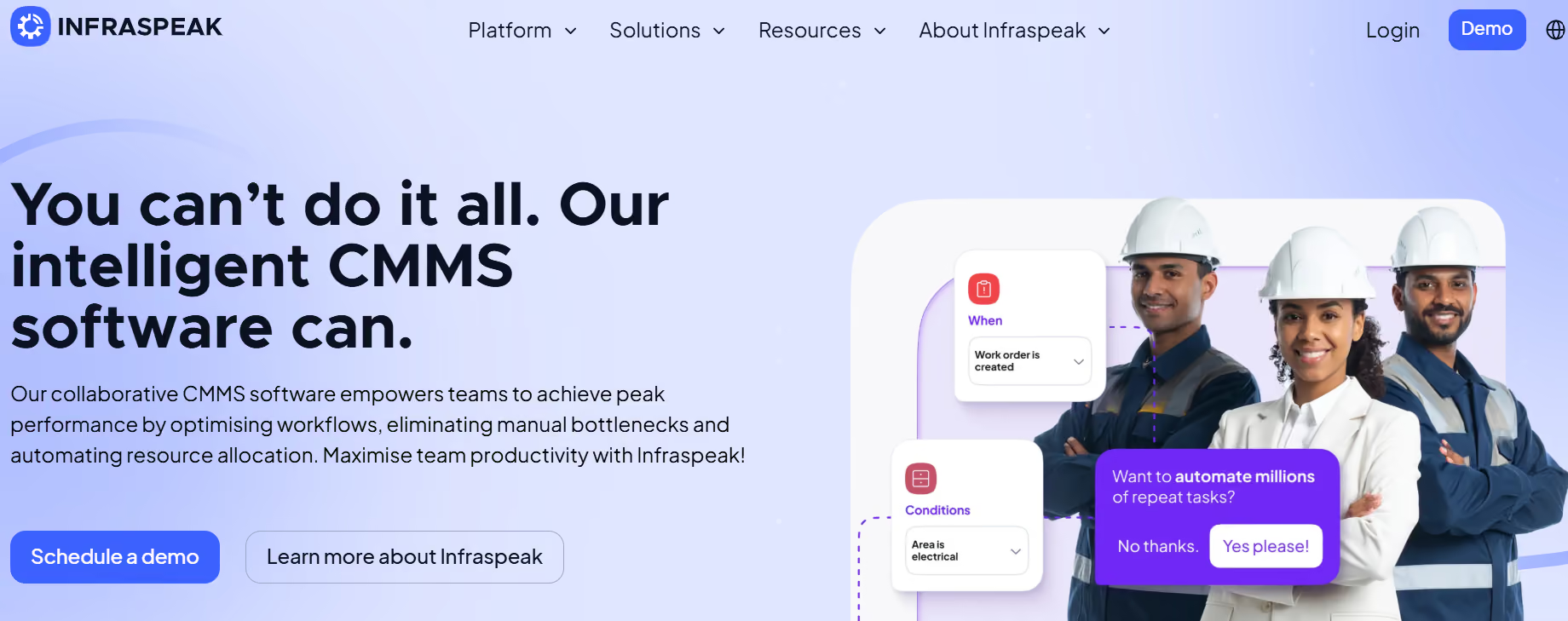
Infraspeak (Porto, Portugal) calls itself an “Intelligent Maintenance Management Platform” and leans into collaboration, connecting in-house teams, suppliers and even customers in one system. It manages 180,000+ buildings worldwide, is a Verdantix-recognised leader for commercial-buildings CMMS, and counts Siemens, Mitsubishi Electric and IHG as customers.
Best for: Facilities and multi-site building operators, hospitality, retail, healthcare, property portfolios that need collaboration and supplier management as much as maintenance.
Pricing: Custom quote.
Key features:
- Strong FM and work-order workflows with real-time notifications
- NFC/QR/barcode asset access and validation
- Supplier and contractor collaboration network
- AI-assisted scheduling, IoT integration, and 100+ integrations
- Broad European language coverage (EN, PT, FR, ES, PL and more)
What we like: Excellent for connecting fragmented FM operations and external service providers in one place.
Keep in mind: Reporting can feel dense, and some users want deeper export/customisation; the sweet spot is facilities rather than heavy production lines.
5. Fracttal One: best for IoT- and AI-forward teams
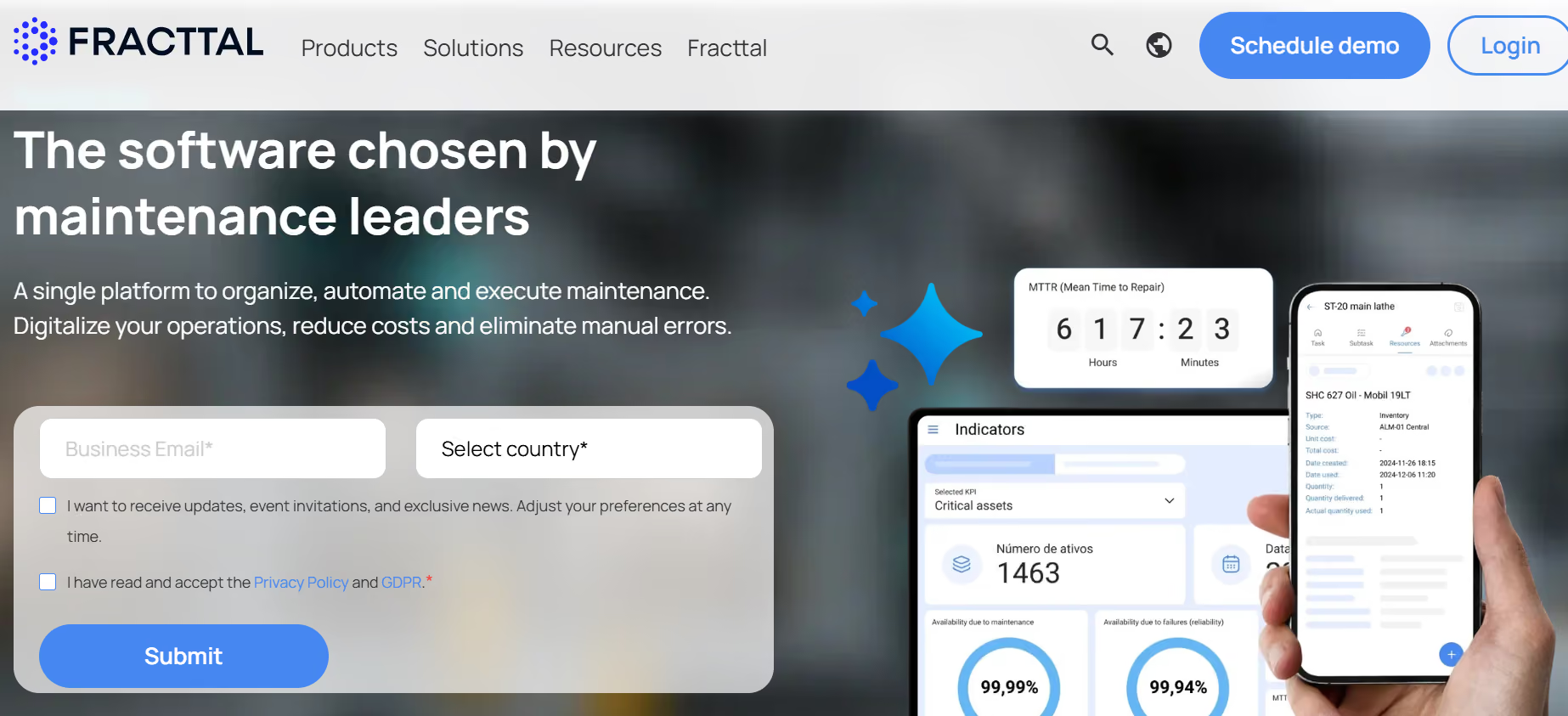
Fracttal One (Spain, with a large LatAm and EMEA base) is the most IoT-native option here. Its Fracttal Sense module connects sensors directly to assets and auto-generates work orders when thresholds are exceeded, so you get genuine condition-based maintenance alongside time- and meter-based plans.
Best for: Teams in Spain, Portugal and wider Southern Europe that want IoT-driven, condition-based maintenance out of the box.
Pricing: Custom quote; a free trial is available.
Key features:
- Sensor-triggered, condition-based PM via Fracttal Sense
- Modern, mobile-first work orders with photos and digital signatures
- KPI dashboards including MTTR, MTBF and PM compliance
- ERP integrations (SAP, Oracle, Salesforce)
- EU and LatAm hosting; strong Spanish/Portuguese localisation
What we like: A polished, quick-to-deploy interface and real IoT depth without enterprise-grade complexity.
Keep in mind: Some users report offline-access and document-management limits; the deepest value requires investing in the sensor side.
6. Siveco Coswin 8i: best for complex, regulated industry (and on-prem)
Coswin 8i (Siveco Group, France) is a CMMS/EAM built for complexity, highly configurable, multilingual, and, crucially for sovereignty-conscious buyers, available on-premise or as SaaS. Its “Coswin Smart Generation” line adds IoT, BIM, GIS and BI, and the Nom@d mobile app works fully offline.
Best for: Regulated or complex industrial and facility operators (agri-food, utilities, buildings) that need maximum control, including full on-premise deployment.
Pricing: From ~€500/month; on-premise licensing also available. Custom-scoped.
Key features:
- SaaS or on-premise deployment (Oracle / SQL Server)
- Deep configurability for complex asset structures
- Multilingual offline mobile app (FR, EN, DE, NL, ES, Greek and more)
- IoT, BIM, GIS and BI via Coswin Smart Generation
- 24/7 support and a worldwide partner network
What we like: The strongest data-sovereignty story on this list; an on-premise option keeps data entirely in your control.
Keep in mind: Enterprise implementations can run several months and are configuration-heavy; best for teams with project resources.
The final two platforms are not European-headquartered, but European teams shortlist them often, so they’re included for completeness. The caveat: as US-incorporated vendors, both carry CLOUD Act exposure regardless of hosting region; confirm EU data-residency terms before buying if compliance is a driver.
7. MaintainX: best mobile-first frontline experience
MaintainX (San Francisco, USA) is widely regarded as having the strongest mobile UX in the category; technicians create, update and close work orders in very few taps, which drives high adoption on the floor.
Best for: Field-heavy teams prioritising adoption and speed, where EU data residency is a preference rather than a hard requirement.
Pricing: Free plan available; paid tiers from ~$16–25/user/month.
Key features:
- Best-in-class mobile work-order experience with offline support
- AI-assisted procedure/SOP generation
- Sensor-based anomaly detection and real-time asset status
- In-work-order messaging and photo capture
- 24/7 support and fast onboarding
What we like: Adoption is almost frictionless, ideal for mixed-tech-comfort crews.
Keep in mind: US jurisdiction (CLOUD Act), and report/field customisation can be limited for complex asset estates.
8. Limble: best for analytics-driven managers
Limble (Lehi, Utah, USA) takes a more management- and data-driven approach, rewarding teams that invest in setup with deep reporting, flexible automation and predictive-maintenance tooling.
Best for: Maintenance managers who want analytics and process structure and don’t have strict EU-residency constraints.
Pricing: Free plan available; paid tiers from ~$28–45/user/month.
Key features:
- Deep reporting and preventive-maintenance visibility
- Flexible automation (auto-assignment, overdue alerts)
- Predictive-maintenance tooling on real-time data
- Strong customisation of dashboards and workflows
- Fast, well-rated support
What we like: Reporting depth and configurability for teams that want data, not just task completion.
Keep in mind: US jurisdiction (CLOUD Act); real-time asset-status tracking is more limited than some rivals, and it rewards a heavier setup effort.
How to choose the right European CMMS for your team
Feature lists look almost identical on paper. Fit only shows up in use. Here’s a short framework to narrow the field:
- Start with your compliance line. If a compliance team, works council, or customer contract requires EU residency or sovereignty, filter to EU-headquartered vendors first (Makula, IFS Ultimo, osapiens, Infraspeak, Fracttal, Coswin). For the strictest control, Coswin’s on-premise option is the safest answer.
- Match the tool to your assets. Production-line manufacturing → Makula, IFS Ultimo, osapiens. Facilities/buildings → Infraspeak. IoT/condition-based ambitions → Fracttal. Enterprise EAM + safety → IFS Ultimo.
- Be honest about maturity. Moving off spreadsheets? Prioritise adoption and time-based PM over an analytics suite you won’t configure.
- Run a real 30-day trial. Load your own asset register, put two or three actual technicians on the mobile app for a week, and run your most common monthly report.
- Check the integration path. Especially SAP/ERP, Osapiens is SAP-certified; others connect via API.
- Cost it over 3–5 years. Include implementation, training, configuration and internal IT time, not just the per-user licence.
Watch for these red flags: quote-only pricing with no ballpark; “GDPR-compliant” claims that really mean US hosting under a US parent; mobile apps that don’t work offline; and predictive-maintenance marketing on a tool you’ll only ever use for time-based PM.
Conclusion
For European maintenance teams in 2026, the right CMMS is the one that clears your compliance bar and gets used on the floor. Need enterprise EAM with safety built in? IFS Ultimo. Running on SAP? osapiens. Facilities and multi-site buildings? Infraspeak. IoT-driven condition-based maintenance? Fracttal One. Maximum control, including on-premise? Siveco Coswin 8i.
And if you’re an asset-heavy manufacturer that wants an EU-built, audit-ready, time-based CMMS your technicians will actually open, without paying for AI features you’ll never switch on, Makula is the most focused fit. The fastest way to know is to put your own assets in front of it: book a free demo and run a real work order this week.