Ask most OEM service leaders whether they know their installed base, and the answer is almost always yes. They will point to a spreadsheet, an ERP export, or a CRM list and say, "It's all in there."
But here is the truth: knowing what you have sold is not the same as having installed base visibility.
A list of serial numbers tells you what was left by your factory. True visibility tells you where that equipment is today, who is operating it, what condition it is in, what service history it carries, and when it will next need attention. That gap, between a static asset list and dynamic, actionable intelligence, is where millions in aftermarket revenue quietly disappear every year.
This blog is not about the problem of data silos or outdated records (those topics have been covered in depth elsewhere). This is about what real installed base visibility looks like, why most machinery manufacturers do not actually have it, and what changes when they do.
Read more: Why Most OEMs Don't Know What's Installed in the Field
The Confusion at the Core: Lists vs. Visibility
There is a widespread and costly misunderstanding in the OEM world. Many organisations believe they have installed base visibility simply because they have a record of every machine they have ever shipped. In reality, what they have is an asset inventory, and the two are fundamentally different things.
Think of it this way. An asset list is a photograph. Installed base visibility is a live feed.
A photograph tells you what something looked like at a single point in time. A live feed shows you what is happening right now, and more importantly, what is likely to happen next.
Nearly 70% of OEM data remains buried in fragmented ERPs, legacy databases, and spreadsheets, making it invisible to the executives who need it most.
This is not a data storage problem; it is a visibility problem. The data exists. It is simply not connected, contextualised, or accessible in a way that drives decisions.
What True Installed Base Visibility Actually Includes
Real installed base visibility is not a single metric or dashboard. It is a connected intelligence layer that answers a specific set of questions in real time:
- Where is the equipment? Not just the customer name, but the precise site, building, or production line.
- What is its current configuration? Has it been modified, upgraded, or had components replaced since installation?
- What is its service history? Every maintenance event, repair, part replacement, and technician note is traceable and current.
- What is its warranty and contract status? Is it covered? When does that coverage expire?
- What is its performance trend? Is output declining? Are fault codes increasing in frequency?
- What does it need next? Predictive insights driven by usage data, not just a calendar-based schedule.
Without answers to all of these questions, not just some of them, an OEM is operating with partial sight. And partial sight, at scale, leads to reactive service delivery, missed revenue, and eroding customer trust.
The Real Cost of Incomplete Visibility
The financial stakes here are significant and well-documented.
Aftermarket services can deliver margins 2–3 times higher than new equipment sales, yet many OEMs capture less than 30% of the available aftermarket opportunity within their installed base.
Approximately two-thirds (67%) of companies indicate that critical and relevant installed base data is distributed between as many as three to four different enterprise systems or applications. The result is that service and sales teams spend more time hunting for data than acting on it.
The vast majority, 90% of companies surveyed, find it somewhat, very, or extremely time-consuming to obtain relevant installed base data and business intelligence.
That is not a minor inconvenience. That is a structural drag on service performance, one that compounds with every new machine shipped, every new customer onboarded, and every year that passes without a connected installed base management system in place.
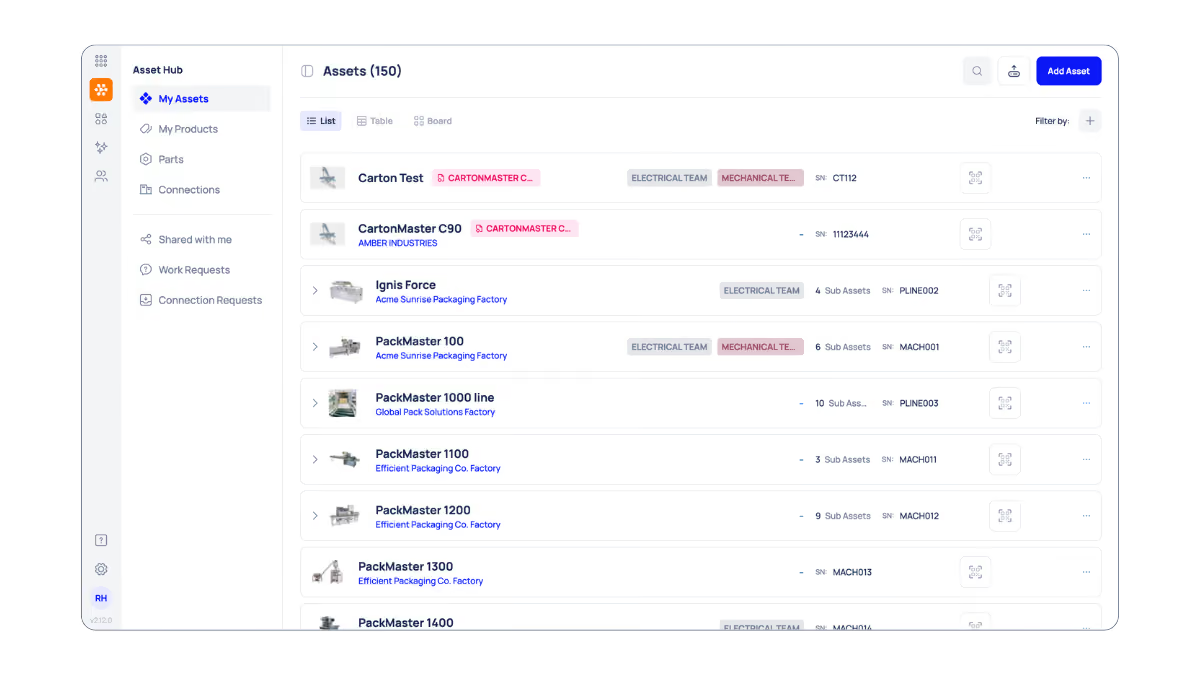
Asset Lists vs. True Visibility: A Direct Comparison
The difference is not incremental. It is the difference between a reactive service model and a proactive one, and the revenue gap between the two is substantial.
A Real-World Example: Komatsu's Approach to Field Asset Visibility
Komatsu, the Japanese construction and mining equipment manufacturer, offers one of the clearest illustrations of what field asset visibility enables at scale.
Komatsu leverages its population of 770,000 active machines to reinforce parts and maintenance pull, providing the foundation for new service models and enabling a shift from reactive repairs to proactive, data-driven solutions. The company's KOMTRAX telematics platform feeds real-time equipment data, location, fuel consumption, operating hours, fault codes, back to Komatsu's service teams and directly to customers.
The commercial impact is significant: Komatsu earns 60% of its profits from its aftermarket business, even though it accounts for 50% of sales, with gross margins on parts and services running at roughly 40–50% compared to 20–30% on original equipment sales.
The key enabler behind this performance is not a superior product; it is superior installed base visibility that allows Komatsu to act before customers even know they need attention.
Why OEM Service Intelligence Requires More Than Good Data
A common mistake is assuming that better data alone solves the visibility problem. It does not.
Raw data, even clean, centralised, well-structured data, is not intelligence. OEM service intelligence is what happens when that data is contextualised, connected to service workflows, and made actionable for the teams who need it.
Consider what happens when a warranty is about to expire. If that information sits in an ERP that nobody checks proactively, it is worthless. But if it triggers an automated alert to the account manager, a personalised recommendation to the customer through their portal, and a suggested service contract offer, that is intelligence driving revenue.
Companies that have implemented an installed base platform become more intelligent about their customer base; they gain better visibility into data, which empowers sales and service personnel to deliver an exceptional customer experience and drive new revenue growth. One service executive reported saving two to three days per month simply by eliminating manual report generation.
This is where platforms like Makula's Installed Base Management feature make a measurable difference, not by storing data, but by transforming it into the kind of operational intelligence that drives decisions.
The Link Between Visibility and Proactive Service Delivery
One of the most direct benefits of true installed base visibility is the ability to shift from reactive to proactive service delivery. This shift is not just operationally better; it is commercially transformative.
When a service team knows that a specific machine model typically experiences a particular failure at around 4,000 operating hours, and they can see which assets in their installed base are approaching that threshold, they can intervene before the failure occurs. The customer avoids unplanned downtime. The OEM avoids an emergency callout. And the interaction, rather than being a crisis, becomes a demonstration of expertise and care.
This is also where remote asset monitoring becomes a genuine competitive advantage rather than a technology novelty. When equipment is connected and feeding live data back to the service team, the window between identifying a potential issue and resolving it shrinks dramatically.
How Visibility Transforms After-Sales Service Optimisation
True visibility does not just improve individual service interactions; it fundamentally reshapes after-sales service optimisation at the organisational level. Here is what changes:
- Service planning becomes data-driven:
Instead of scheduling maintenance based on generic time intervals, teams can prioritise based on actual usage patterns, environmental conditions, and historical failure data for each specific machine. - Parts inventory becomes predictive:
When you know which assets are approaching service milestones and what parts they will need, procurement stops being reactive. Lead times shrink. Stock-outs become rare. First-time fix rates improve. - Revenue forecasting becomes reliable:
Providing visibility into specific assets approaching the end of warranty period automatically triggers sales and marketing activities for extended warranties, service contracts, or replacement parts, turning what was previously a missed conversation into a consistent revenue stream. - Customer relationships become stickier:
When an OEM can tell a customer that their machine is running 12% below its optimal efficiency threshold and recommend a corrective action before the customer has noticed anything, that is the kind of partnership that is genuinely difficult to replace.
The Role of Equipment Service Records in Closing the Visibility Gap
One of the most under-appreciated dimensions of installed base visibility is the quality and completeness of equipment service records.
Every technician visit, every part replaced, every fault logged, this information is the raw material of intelligence. But in most OEM organisations, it is incomplete, inconsistently recorded, and scattered across systems. A job sheet in a field service tool. A parts order in the ERP. A technician's note in an email.
When service records are fragmented, visibility is always partial. You might know that a machine was serviced, but not what was done, what was found, or what was left unresolved.
Connecting service record capture to the broader visibility framework, so that every interaction adds to a cumulative, accessible picture of each asset, is one of the highest-leverage improvements an OEM can make.
Tools such as Makula's Help Desk and Ticketing feature support exactly this by ensuring that every service interaction is logged, linked to the relevant asset, and available to whoever needs it next.
Asset Lifecycle Tracking: Visibility Across the Entire Journey
Asset lifecycle tracking extends the visibility concept across the full lifespan of a piece of equipment, from commissioning through to end-of-life. This matters because the service opportunities, the risks, and the customer needs change significantly at each stage.
- Early life: Commissioning support, operator training, warranty management
- Mid-life: Preventive maintenance, performance optimisation, software upgrades
- Late life: Refurbishment assessments, replacement planning, extended service agreements
Without lifecycle visibility, OEMs are perpetually catching up. With it, they can engage customers at the right moment with the right conversation, not because a salesperson happened to remember, but because the system surfaced the opportunity automatically.
As explored in The Risk of Missed Preventive Maintenance Without Asset Visibility, the consequences of failing to act at the right point in an asset's lifecycle go well beyond missed revenue; they directly affect customer safety and uptime.
Where Most OEMs Actually Stand Today
Despite the clear business case, most OEMs are still operating with significant visibility gaps, and the gap tends to widen as they grow.
Without installed base visibility, OEMs lose millions in aftermarket revenue, miss renewal opportunities, and make strategic decisions based on partial information; in short, leaders are flying blind across the most valuable part of their business.
The root causes are well understood: decades of growth through acquisitions, geographic expansion, and organic scaling have left most large OEMs with a patchwork of disconnected systems. ERP, CRM, FSM, each holds a fragment of the picture, but none holds the whole.
Addressing this does not require replacing every system. It requires a connected intelligence layer that aggregates, unifies, and contextualises data from across those systems into a single, actionable view.
As described in How Unlinked Systems Create Blind Spots in OEM Service Teams, the problem is rarely a lack of data; it is the absence of a framework that makes that data useful.
Taking the First Step Towards Real Visibility
For OEMs ready to move from asset lists to true installed base visibility, the path forward is more practical than it might appear:
- Audit what data you actually have and where it lives. Map every system that touches asset or service information.
- Identify the highest-value gaps where missing data points are costing you the most in missed service opportunities or reactive callouts?
- Connect before you rebuild. In most cases, the priority is integration and unification of existing data, not wholesale system replacement.
- Make visibility actionable; data without workflows is still just data. Build the alerts, triggers, and customer-facing touchpoints that convert insight into action.
- Start with a pilot, choose a product line or customer segment, establish visibility there, demonstrate ROI, and scale.
- Always involve your service teams from day one. The technicians and account managers who interact with customers daily are both the primary users and the primary source of the data that makes visibility possible. Their buy-in is not optional; it is foundational.
Conclusion
An asset list is the beginning of visibility, not the end of it. True installed base visibility is the difference between knowing what you sold and understanding what is happening across your entire deployed fleet, in real time, at every stage of the asset lifecycle.
For OEMs, the commercial case is clear. The operational benefits are proven. And the technology to make it happen is available today.
The question is not whether visibility is worth pursuing; it is how much longer you can afford to operate without it.