The email arrives with a subject line that makes your stomach drop: "Urgent: Uptime and Cost Data Needed." An executive is preparing for a board meeting and needs the performance numbers for the top ten most critical assets over the last quarter—by the end of the day.
For many maintenance and operations managers, this triggers a frantic, high-stakes data hunt. Team members are pulled from their tasks to sift through spreadsheets, work order notes, and logbooks. The process is manual, stressful, and slow. By the time you piece together a response, it’s often incomplete, lacking confidence, and delivered hours or even days late.
Why Missing KPIs Hurt Operational Decisions
Operating without clear, accessible Key Performance Indicators (KPIs) creates an information vacuum. Decisions are delayed, resources are misallocated, and your department struggles to demonstrate its value.
To move from constant reaction to strategic control, you need to track the right maintenance KPIs, ideally through a modern CMMS like Makula, which centralises asset and work order data in one place.
The Hidden Costs of Not Tracking KPIs
1. Delayed Decision-Making
Leadership relies on operational data to make critical business decisions. Without KPIs, decisions are based on gut feelings instead of hard data, causing postponements and missed improvement opportunities.
2. Weak Budget Justification
During budget season, unsupported claims sound subjective:
- Without KPIs: “We need a bigger budget because the team feels overworked.”
- With KPIs (Makula-enabled): “Our MTTR on production-critical assets rose by 20%, causing £250,000 in lost revenue last year. Using Makula CMMS, we can reduce downtime by 40%, delivering clear ROI within six months.”
3. Eroded Credibility and Morale
When leadership constantly chases you for basic performance data, trust erodes. Your team sees their efforts unrecognized, recurring issues remain unaddressed, and frustration builds.
Core Maintenance KPIs Every Manager Should Track
Not all metrics are created equal. Focus on a handful that show efficiency, reliability, and cost-effectiveness.
Reactive vs. KPI-Driven Operations
Makula CMMS ensures all these KPIs are captured automatically, providing a single source of truth for your operations.
How to Start Tracking KPIs Effectively
- Define What to Measure
Track the basics first: uptime, MTBF, MTTR, and maintenance cost as a percentage of asset value. - Standardize Data Capture
Use a CMMS like Makula to log all work orders consistently. Dropdown menus and required fields ensure clean data feeding your KPIs. - Automate Reporting
Makula CMMS calculates KPIs in real-time and displays them on dashboards—no more manual report building.
How Makula CMMS Helps Managers Make Data-Driven Decisions
From Reactive to Proactive Operations, Makula CMMS centralises all asset data, work orders, and maintenance histories:
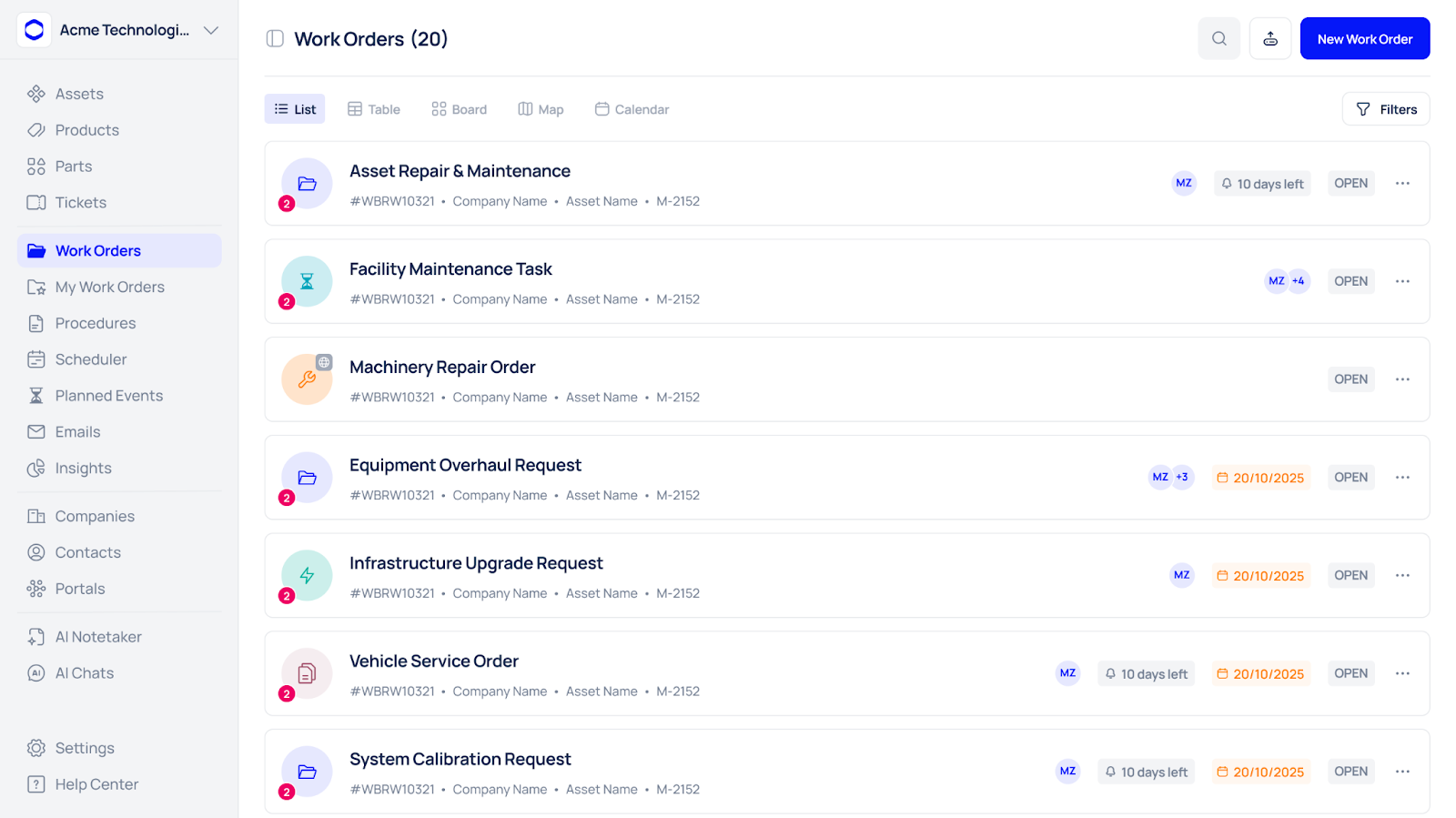
- Generate executive-ready KPI reports in seconds.
- Spot underperforming assets and recurring failures.
- Track technician performance and efficiency in real-time.
- Align maintenance actions with business objectives to prove ROI.
With Makula, managers stop firefighting and start leading operations with confidence.
Real-World Impact: How Makula CMMS Transforms Operations
A modern CMMS isn’t just about tracking data—it’s about delivering measurable results. Organizations using Makula CMMS have seen dramatic improvements in maintenance efficiency and uptime.
A manufacturing plant using Makula CMMS reduced unplanned downtime by 35% in just 3 months. With real-time KPI tracking, they could prioritize maintenance on high-risk assets, saving over £100,000 annually in lost production.
Key results include:
- Before Makula: MTTR averaged 12 hours per critical asset.
- After Makula: MTTR reduced to 7 hours, uptime increased 15%.
- Maintenance costs decreased by 20% due to proactive work order scheduling.
By centralizing data and automating KPI tracking, Makula CMMS turns operational insights into actionable outcomes.
Why Manual Tracking Is Costing You Money
Manual maintenance tracking hides significant costs and leaves your team in reactive mode:
- Lost revenue from unplanned downtime.
- Overtime costs for emergency fixes.
- Risk of equipment failure causing production bottlenecks.
Makula CMMS solves these problems automatically:
- Real-time dashboards give instant visibility into asset performance.
- Automated reporting reduces hours spent compiling spreadsheets.
- Proactive alerts help prevent failures before they occur.
Investing in Makula is not an expense, it’s a strategy to save money while improving reliability and efficiency.
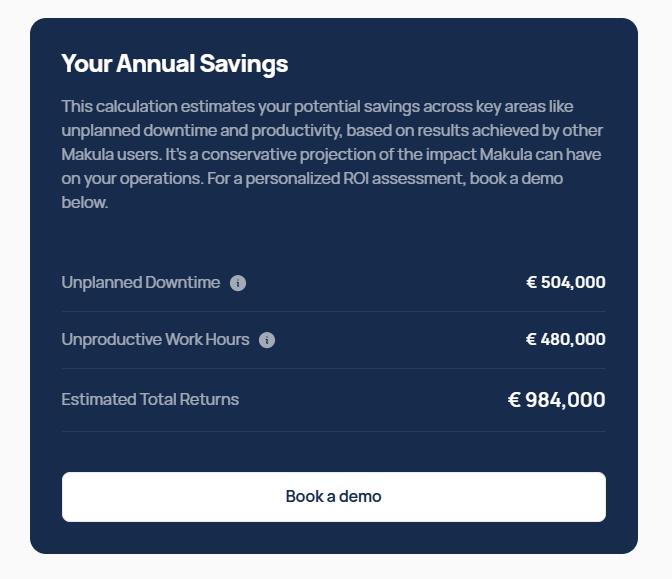
Estimate Your ROI
Understanding the financial impact of downtime makes the value of a CMMS clear.
If your plant experiences 10 hours of unplanned downtime per month on critical assets, and the average cost per hour is £2,500, that’s £250,000 lost annually. With Makula CMMS, you can reduce downtime by up to 40%, potentially saving £100,000+ per year.
Common Objections and How Makula Solves Them
Many teams hesitate to implement a new CMMS, but Makula addresses common concerns:
By addressing these objections upfront, you can guide prospects from curiosity to action.